President Donald J. Trump signed the Holocaust Expropriated Art Recovery Act of 2025 into law today, April 13, 2026. The law extends the provisions of the Holocaust Expropriated Art Recovery Act (HEAR Act) of 2016 with respect to the statute of limitations on Nazi-era art recovery claims in U.S. courts, repudiates the Supreme Court’s ruling in F.R.G. v. Philipp, 141 S. Ct. 703 (2021), and prohibits certain other defenses to such claims.
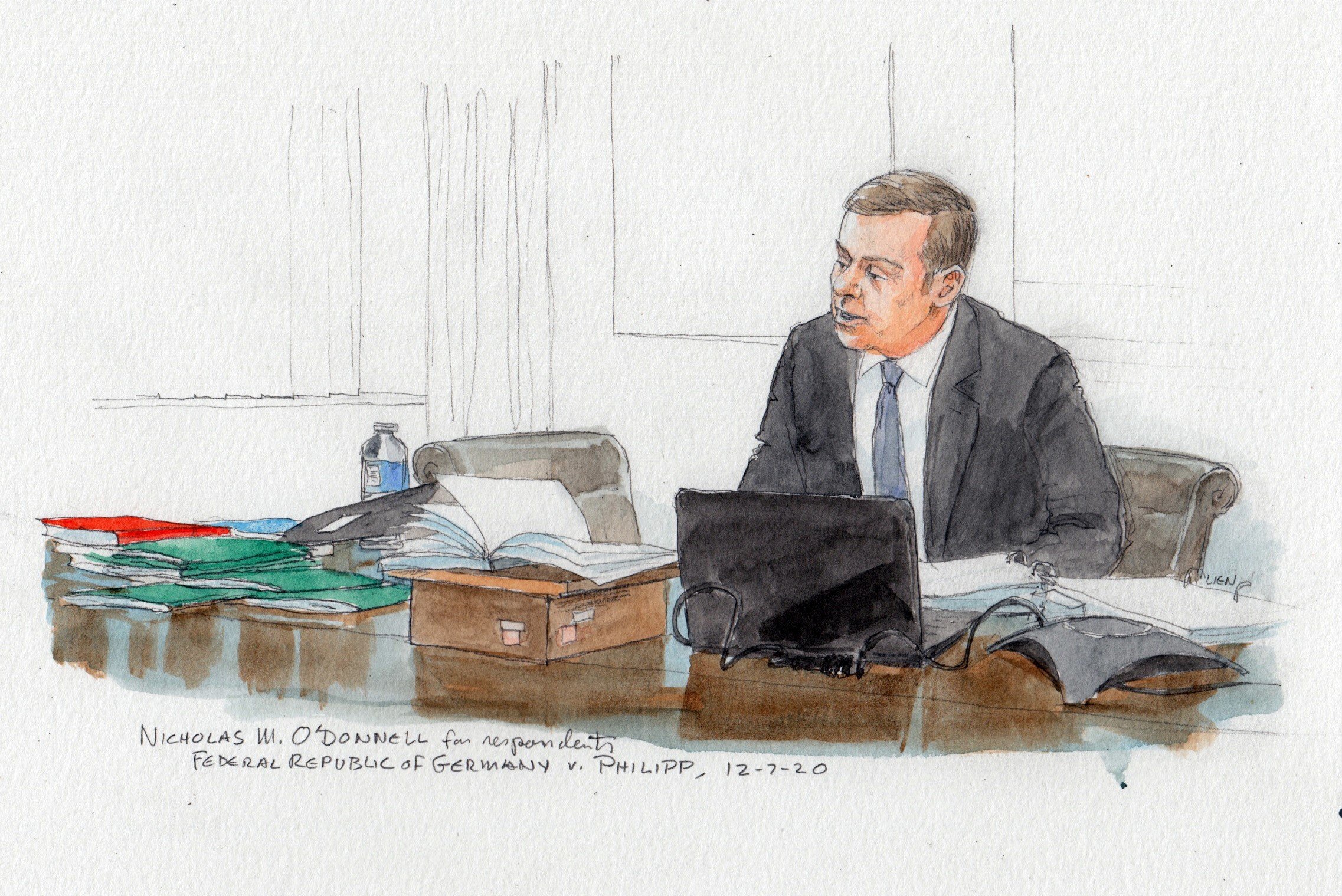
I argued the Philipp case on behalf of the heirs whose ancestors were the consortium of dealers forced to sell the Welfenschatz, or Guelph Treasure, to a cabal of Nazi front men before Hermann Goering presented the collection to Hitler as a gift. Philipp held that Nazi art loss victims from Germany were not the subject of takings in violation of international law because they were “domestic takings” that thus enjoyed sovereign immunity under the Foreign Sovereign Immunities Act (FSIA). The new law is a major development that undercuts the increasingly bad-faith assertion of sovereign immunity against the heirs of Holocaust art theft victims in and since Philipp, and welcome Congressional action for which I advocated in my article last year, “Turnabout is Foul Play: Sovereign Immunity and Cultural Property Claims,” 28 Chap. L. Rev. 553 (2025).
The critical aspects of the law are as follows:
-
It extends the original HEAR Act, which nationalized the statute of limitations for Nazi-era art claims at six years from the actual discovery of the facts and circumstances necessary to bring a claim, subject to certain carveouts for previously-known claims. This replaced constructive knowledge and typical three year limits, which is the standard under most state law statutes of limitations. In contrast to the original HEAR Act’s ten-year sunset provision, the law now has no expiration.
-
It expressly overrules Philipp, which granted sovereign immunity to Germany and its museums by importing a limitation on so-called “domestic takings” never expressed by Congress into the text of the expropriation exception in the FSIA. The result of Philipp was that heirs to the Nazis’ first art theft victims—Jews from Germany—were left without recourse. This law repudiates that ill-reasoned decision (requiring jurisdictional analysis " without regard to the nationality or citizenship of the alleged victim") and vindicates the argument that we made for our clients at the time.
-
The law also rebukes the statements in Philipp that the 2016 HEAR Act—which opened the courthouse doors—was somehow a law primarily directed to out of court solutions, now stating unequivocally: “The intent of this Act is to permit claims to recover Nazi-looted art to be brought.” That should be clear enough.
-
Finally, the law eliminates other potential defenses to Nazi-era claims such as laches, forum non conveniens, international comity abstention, and the Act of State Doctrine, none of which were addressed in the 2016 law. Comity abstention and the Act of State Doctrine in particular have given rise to extraordinary mischief by foreign states seeking to avoid the merits of their illicit possession of Nazi-confiscated art.
Read More
Topics:
Legislation,
laches,
Act of State,
Foreign Sovereign Immunities Act,
FSIA,
expropriation exception”,
NS Raubkunst,
Statute of Limitations,
Federal Republic of Germany,
HEAR Act,
Nazi-confiscated art,
Philipp v. F.R.G.,
domestic takings
The Supreme Court of the United States has invalidated the sweeping reciprocal tariff regime enacted by the Trump Administration last year, purportedly pursuant to the International Emergency Economic Powers Act (50 U.S.C. §§ 1701, et seq.) (IEEPA). In its opinion issued on February 20, 2026 in Learning Resources, Inc. v. Trump, 145 S.Ct. 2811 (2026) authored by the Chief Justice, the Court held that IEEPA’s delegation to the President to restrict imports does not extend to the capricious array of tariffs that the Administration imposed, raised, and lowered as it saw fit.
Read More
Topics:
Trump Administration,
Tariffs,
IEEPA
I am delighted to announce that the New York chapter of the Responsible Art Market Initiative and Christie’s have organized an event on September 25, 2025, at Rockefeller Center: “Mitigating Risk in an Uncertain World.” Co-chair Birgit Kurtz and I will offer opening and closing remarks to table-set for a fantastic panel, and to look ahead to RAM’s 10th Annual Conference in Geneva in January (more to come on that soon).
Read More
Topics:
Christie's,
Events,
Responsible Art Market initiative,
Birgit Kurtz,
Bank of America Private Bank,
Nicole Jacoby,
Margaret Hoag,
Dana Prussian Haney,
Anne Rappa,
Marsh McLennan
I am proud to announce the publication in the Chapman Law Review of my article: “Turnabout is Foul Play: Sovereign Immunity and Cultural Property Claims,” which you can link to here. The abstract of the article is below.
Read More
Topics:
Second Hickenlooper Amendment,
Act of State,
Nazi-looted art,
Foreign Sovereign Immunities Act,
FSIA,
expropriation exception”,
28 U.S.C. § 1605(a)(3),
Genocide Convention,
Nazi-confiscated art,
F.R.G. v. Philipp,
domestic takings,
Chapman Law Review,
Turnabout is Foul Play,
Sovereign Immunity and Cultural Property Claims,
Roberts Court,
Taline Ratanjee,
Greg Mikhanjian,
Anna Ross,
Amber Odell,
Sara Morandi
Senator Jon Cornyn (R-TX) introduced the Holocaust Expropriated Art Recovery Act of 2025 on May 22, 2025, as Senate Bill 1884, with seven co-sponsors. The bill would extend provisions of the Holocaust Expropriated Art Recovery Act (HEAR Act) of 2016 with respect to the statute of limitations on Nazi-era art recovery claims in U.S. courts, and would rebuke the Supreme Court’s disastrous ruling in 2021 that Nazi art loss victims from Germany were not the subject of takings in violation of international law. The bill is an important step in Holocaust-era art claims and should be passed.
Read More
Topics:
laches,
Act of State,
Statute of Limitations,
Holocaust Expropriated Art Recovery Act,
Richard Blumenthal,
HEAR Act,
Genocide Convention,
Nazi-confiscated art,
F.R.G. v. Philipp,
Marsha Blackburn,
Eric Schmidt,
Katie Boyd Britt,
domestic takings,
Cory Booker,
Thomas Tillis,
Chapman Law Review,
forum non conveniens,
John Fetterman
Making Sense of Canada, Mexico Tariffs in the Art Market
Read More
Topics:
The Art Newspaper,
Customs,
President,
COVID-19,
White House,
Mexico,
Canada,
Constitution,
Customs and Border Protection,
Tariffs,
Tariff Act of 1930,
Smoot-Hawley,
Federal Register,
Department of Homeland Security,
Higher Education Act of 1965,
Notice of Implementation of Additional Duties,
International Emergency Economic Powers Act,
National Emergencies Act,
50 U.S.C. § 1702(a)(1)(B),
Administrative Procedures Act,
HEROES Act,
Biden v. Nebraska,
Loper Bright Enterprises v. Raimondo
I was honored to take part in a symposium last February at the University of Kansas School of Law entitled “A Museum’s Purpose,” which addressed a variety of cultural property related topics. KU was a wonderful host, and Lawrence is a charming town. I spent a great weekend in Kansas City (which was perfect aside from the then-recent Chiefs Super Bowl win-Go Pats!), saw a Jayhawks basketball game, and even visited the grave of Dr. James Naismith, who invented the great sport of basketball in Springfield, Massachusetts.
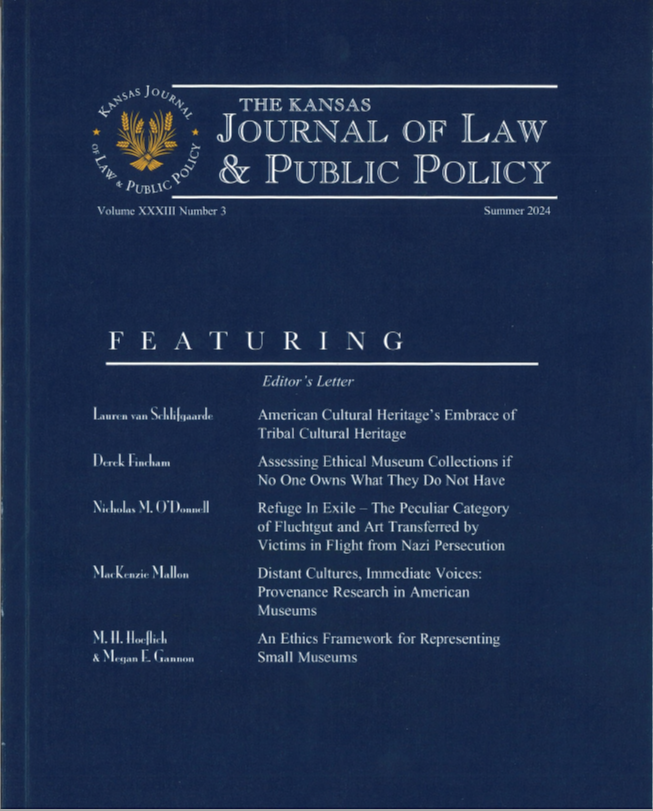
I am pleased to announce that the article I wrote for the symposium has been published in the Kansas Journal of Law & Public Policy. Entitled “Refuge in Exile—the Peculiar Category of Fluchtgut and Art Transferred by Victims in Flight from Nazi Persecution,” my paper seeks to address the legal status of works that changed hands in the Nazi era that are not strictly covered by the more familiar frameworks of Nazi expropriation and forced sales that have been the focus of most of the discussion since the Washington Conference in 1998, and propose a judicial and analytical framework to deal with them. In my own practice this year, the Allentown Cranach story is an illustrative example.
Read More
Topics:
University of Kansas,
South Texas College of Law,
Washington Conference Principles,
UCLA School of Law,
Nazi persecution,
flight goods,
Derek Fincham,
Fluchtgut,
Dr. James Naismith,
Lauren Van Schilfgaarde,
MacKenzie Mallon,
Michael Hoeflich,
Kansas Journal of Law & Public Policy,
The Nelson-Atkins Museum of Art,
Megan Gannon
As co-chair (with Birgit Kurtz) of the New York chapter of the Responsible Art Market Initiative, I hope you will join us for a two-part webinar focusing on data in the art market. The webinars will take place on October 30, 2024, and November 6, 2024. Registration is available here.
Read More
Topics:
Emigrant Bank Fine Art Finance,
Yale University,
Suzanne Gyorgy,
Winston Art Group,
Responsible Art Market initiative,
Nanne Dekking,
Artory,
Charles Moffett Gallery,
ArtTactic,
Magnus Resch,
Minerva Pinto,
Goldman Sachs,
Ann Tenenbaum,
Erica Barrish,
EAB Fine Art Services,
Charles Moffett, Jr.,
Anders Petterson
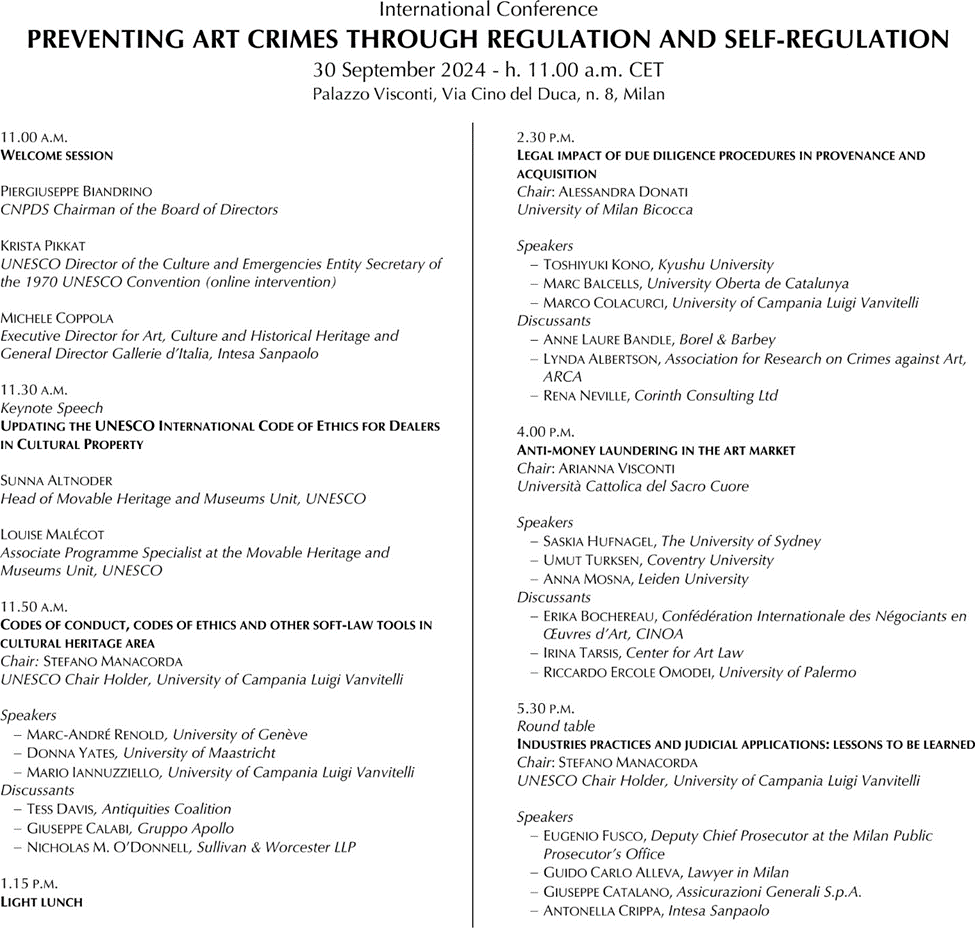
I am pleased to announce that I will be among the speakers in Milan on September 30, 2024 at a conference organized by the Universitá degli Studi della Campania Luigi Vantivelli and the UNESCO Chair on Business Integrity and Crime Prevention in Art and Antiquities Market: “Preventing Art Crimes Through Regulation and Self-Regulation.” To be held at the Palazzo Visconti, the conference will offer a full day of expert speakers on the topics of Updating the UNESCO International Code of Ethics for Dealers in Cultural Property; Codes of Conduct, Codes of Ethics and Other Soft Law Tools in Cultural Heritage (in which I will be a discussant); the Legal Impact of Due Diligence Procedures and Acquisition, Anti-Money Laundering in the Art Market; and Industry Practices and Judicial Applications: Lessons to be Learned. The program is below, and registration may be found here.
As the title and expertise of the participants suggest, this will be an excellent broad view of the question of regulation in cultural property, and the extent to which market participants can guide the outcome. It will focus on public-private partnerships for the prevention of wrongdoings against cultural property, and specific attention will be devoted to the role that codes of conduct, due diligence, and KYC procedures play in this area. I am excited to be a part of the event and see many old friends. I hope that if you are nearby you will join us, or attend remotely if you are not.
Read More
Topics:
Anne Laure Bandle,
Irina Tarsis,
Saskia Hufnagel,
Events,
UNESCO,
ARCA,
Center for Art Law,
Leiden University,
Borel & Barbey,
Giuseppe Calabi,
Sunna Altnoder,
Louise Malécot,
Stefano Manacorda,
Universitá Luigi Vantivelli,
Tess Davis,
Antiquities Coalition,
Alessandra Donati,
University of Milan Bicocca,
Toshiyuki Kono,
Kyushu University,
Marc Balcells,
Marco Colacurci,
Lynda Albertson,
Association for Research on Crimes Against Art,
Rena Neville,
Corinth Consulting Ltd.,
Arianna Visconti,
Universitá Cattolica del Sacro Cuore,
Umit Turksen,
Coventry University,
Anna Mosna,
Erika Bochereau,
CINOA,
Riccardo Ercole Omodel,
University of Palermo,
Eugenio Fusco,
Milan Public Prosecutor,
Guido Carlo Alleva,
Giuseppe Catalano,
Assicurazioni Generali S.p.A.,
Antonella Crippa,
Intesa Sanpaolo,
Palazzo Visconti,
University Oberta de Catalunya,
University of Sydney
The U.S. Court of Appeals for the D.C. Circuit recently dismissed a long-running dispute against Russia concerning the library of the Lubavitcher Rebbe (the Library), a collection of books and papers once held by the then-Rebbe of the Chabad Lubavitch movement. Agudas Chasidei Chabad of United States v. Russian Fed’n, 110 F.4th 242 (D.C. Cir. 2024) (Chabad 2024). Brought under what is known as the expropriation exception, 28 U.S.C. § 1605(a)(3), of the Foreign Sovereign Immunities Act (the FSIA), the case has involved Russia’s withdrawal from the case and default, sanctions of $50,000 per day for non-compliance and a judgment of more than $175 million, a retaliatory embargo on cultural property exchange that continues to this day, and multiple appeals.
In the most recent decision, the court of appeals held that the second element of the expropriation exception (what is known as the commercial nexus requirement) was not met and therefore deprived the court of any jurisdiction. Specifically, the D.C. Circuit held that if the defendant is the foreign state, the expropriation exception may only be invoked if the property is physically present in the United States (which the Rebbe’s library is not). The Supreme Court has declined to review two relatively recent cases that reached the same conclusion, it will bear watching of the plaintiffs seek further review now given a circuit split with the 9th Circuit on the issue.
Read More
Topics:
de Csepel,
Immunity from Seizure,
Foreign Sovereign Immunities Act,
Supreme Court,
Agudas Chasidei Chabad,
Russian Federation,
FSIA,
expropriation exception”,
sovereign immunity,
Russian State Library,
Chabad,
Federal Republic of Germany,
Welfenschatz,
D.C. Circuit,
Federal Republic of Germany v. Philipp,
Simon v. Republic of Hungary,
Lubavitcher Rebbe,
Schubarth,
Judge Randolph,
Brett Kavanaugh,
Judge Griffith