
President Donald J. Trump signed the Holocaust Expropriated Art Recovery Act of 2025 into law today, April 13, 2026. The law extends the provisions of the Holocaust Expropriated Art Recovery Act (HEAR Act) of 2016 with respect to the statute of limitations on Nazi-era art recovery claims in U.S. courts, repudiates the Supreme Court’s ruling in F.R.G. v. Philipp, 141 S. Ct. 703 (2021), and prohibits certain other defenses to such claims.
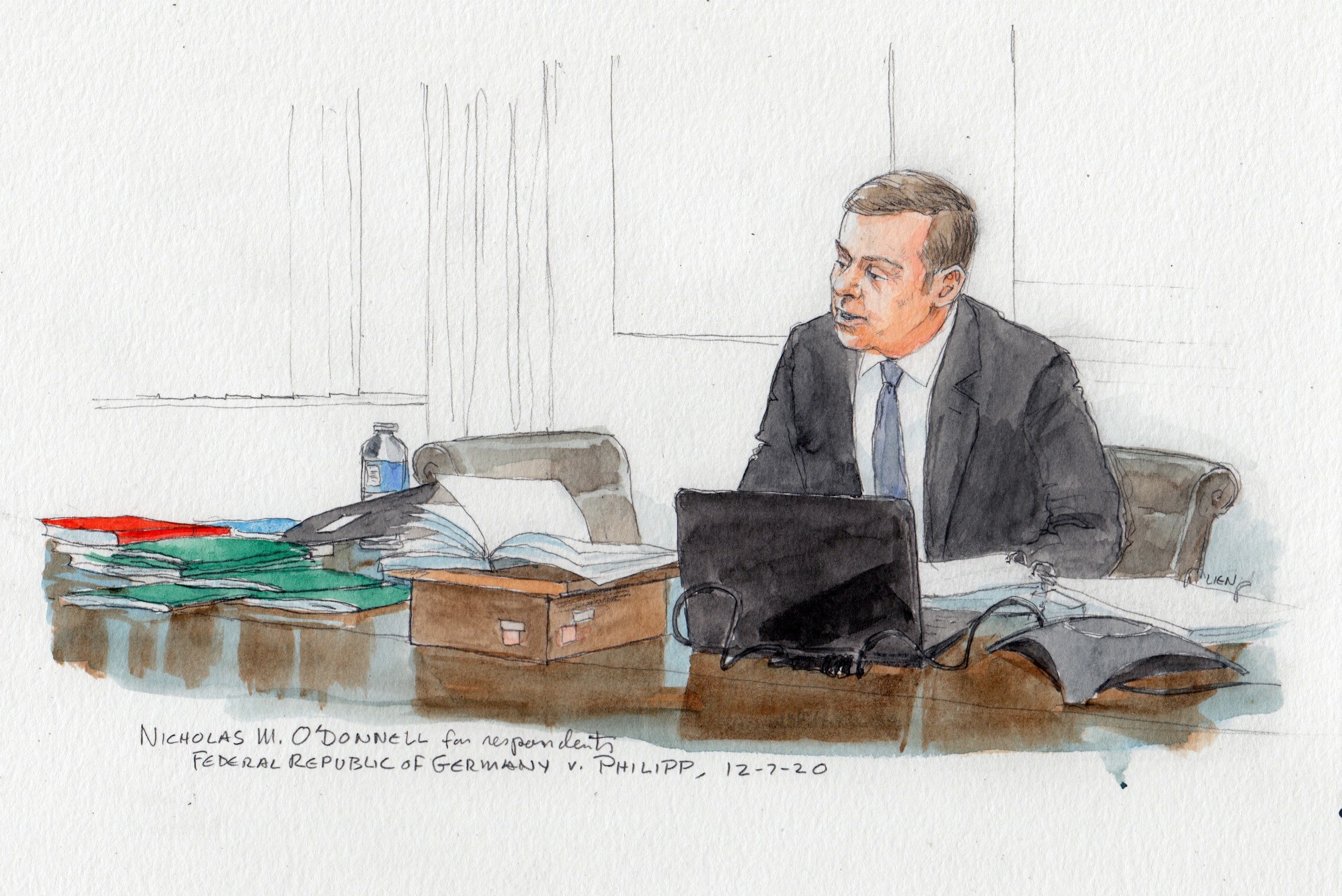
I argued the Philipp case on behalf of the heirs whose ancestors were the consortium of dealers forced to sell the Welfenschatz, or Guelph Treasure, to a cabal of Nazi front men before Hermann Goering presented the collection to Hitler as a gift. Philipp held that Nazi art loss victims from Germany were not the subject of takings in violation of international law because they were “domestic takings” that thus enjoyed sovereign immunity under the Foreign Sovereign Immunities Act (FSIA). The new law is a major development that undercuts the increasingly bad-faith assertion of sovereign immunity against the heirs of Holocaust art theft victims in and since Philipp, and welcome Congressional action for which I advocated in my article last year, “Turnabout is Foul Play: Sovereign Immunity and Cultural Property Claims,” 28 Chap. L. Rev. 553 (2025).
The critical aspects of the law are as follows:
- It extends the original HEAR Act, which nationalized the statute of limitations for Nazi-era art claims at six years from the actual discovery of the facts and circumstances necessary to bring a claim, subject to certain carveouts for previously-known claims. This replaced constructive knowledge and typical three year limits, which is the standard under most state law statutes of limitations. In contrast to the original HEAR Act’s ten-year sunset provision, the law now has no expiration.
- It expressly overrules Philipp, which granted sovereign immunity to Germany and its museums by importing a limitation on so-called “domestic takings” never expressed by Congress into the text of the expropriation exception in the FSIA. The result of Philipp was that heirs to the Nazis’ first art theft victims—Jews from Germany—were left without recourse. This law repudiates that ill-reasoned decision (requiring jurisdictional analysis " without regard to the nationality or citizenship of the alleged victim") and vindicates the argument that we made for our clients at the time.
- The law also rebukes the statements in Philipp that the 2016 HEAR Act—which opened the courthouse doors—was somehow a law primarily directed to out of court solutions, now stating unequivocally: “The intent of this Act is to permit claims to recover Nazi-looted art to be brought.” That should be clear enough.
- Finally, the law eliminates other potential defenses to Nazi-era claims such as laches, forum non conveniens, international comity abstention, and the Act of State Doctrine, none of which were addressed in the 2016 law. Comity abstention and the Act of State Doctrine in particular have given rise to extraordinary mischief by foreign states seeking to avoid the merits of their illicit possession of Nazi-confiscated art.

 Congress Meant What it Said in 1976 About Sovereign Immunity
Under the FSIA, a foreign state is immune from suit unless one of the exceptions set out in the FSIA are met. The “expropriation exception” of 28 U.S.C. § 1605(a)(3) removes sovereign immunity over claims “in which rights in property taken in violation of international law are in issue” and other commercial activity criteria are met. That exception had been understood to cover Nazi thefts of art before the Philipp court reversed course. See Cassirer v. Kingdom of Spain, 616 F.3d 1019, 1027 (9th Cir. 2010) (painting sold for paltry sum by Lilly Cassirer to finance flight of German Jew constituted taking in violation of international law); de Csepel v. Republic of Hung., 808 F. Supp. 2d 113,129-30 (D.D.C. 2011) (illegitimate acquisition Herzog collection by Hungary); Altmann v. Republic of Aus., 317 F.3d 954, 968-69 (9th Cir. 2002), aff’d in part by Republic of Aus. v. Altmann, 541 U.S. 677, 682 (2004) (the Klimt Portrait of Adele Bloch-Bauer “Woman in Gold” case); de Csepel v. Republic of Hung., 169 F.Supp.3d 143 (D.D.C. 2016); Malewicz v. City of Amsterdam, 362 F. Supp. 2d 298, 307 (D.D.C. 2005) (paintings left for safekeeping by Kazimir Malevich with custodian later persecuted by Nazis warranted later jurisdiction against current sovereign possessor of artworks); see also Berg v. King. of the Netherlands, Civil Action No.: 2:18-cv-3123-BHH, 2020 U.S. Dist. LEXIS 84489, at * 32-33 (D. S.C. Mar. 6, 2020) (“These allegations, considered in the grim context of the Nazis’ persecution of Jews during World War II, suffice to show at this juncture that the coerced sale of the Artworks was consistent with the Nazis’ pursuit of the Final Solution”).
Only when the Stiftung Preussischer Kulturbesitz and the Federal Republic of Germany took a distortion-at-best view of their historic crimes (arguing such things as “the Holocaust did not begin until several years after 1935”) to defend theft from German Jews as beyond international concern did the Supreme Court decide to rewrite the FSIA—to harm German Jews’ heirs.
Philipp was a textbook example of a court legislating words into a statute that Congress chose not to express. The Genocide Convention of 1948 includes property theft and was emphatically part of international law when the FSIA was passed in 1976. Hitler’s art theft was explicitly referenced in the FSIA legislative history. That genocidal property takings violate international law was sufficiently obvious that even Bavaria—by far the most recalcitrant of German federal states on Nazi-era art theft—went out of its way to concede the point in litigation. Hulton v. Bayerische Staatsgemäldesammlungen, Case No. 1:16-cv-09360-RJS, Defendants’ Memorandum of Law in Support of Their Motion to Dismiss the Complaint for Lack of Subject Matter Jurisdiction Under The FSIA [ECF No. 26] (November 15, 2017) (“the usual ‘domestic takings rule’ whereby ‘a foreign sovereign’s expropriation of its own national’s property does not violate international law’ does not apply where the foreign state is engaged in genocide. . . .”) (emphasis added). The idea that Congress meant to exclude “domestic takings” constituting genocide—a term coined to describe what was done to German Jews—from international law, but never said so, was always wrong.
Indeed, barely three years before Phillip, the Supreme Court had acknowledged the longstanding principle that “there are fair arguments to be made that a sovereign’s taking of its own nationals’ property sometimes amounts to an expropriation that violates international law, and the expropriation exception provides that the general principle of immunity for these otherwise public acts should give way.” Bolivarian Republic of Venez. v. Helmerich & Payne Int’l Drilling Co., 137 S. Ct. 1312, 1316 (2017). See also Abelesz v. Magyar Nemzeti Bank, 692 F.3d 661, 675 (7th Cir. 2012) (“All U.S. courts to consider the issue recognize genocide as a violation of customary international law.”). Helmerich was decided after the 2017 denial of immunity by the District Court in Philipp (affirmed by the D.C. Circuit in 2018); that decision is even cited in Helmerich. "Sometimes" somehow became "never."
Congress had made clear its view repeatedly over the years about the gravity of the Nazis’ international art crimes. See Justice for Uncompensated Survivors Today (JUST) Act, Pub. L. No. 115-171, 132 Stat. 1288 (2017); Holocaust Expropriated Art Recovery (HEAR) Act of 2016, Pub. L. No. 114-308, 130 Stat. 1524, § 4(3) (2016); Holocaust Victims Redress Act (HVRA), No. 105-158,112 Stat. 15 (1998). Most relevant, Congress adopted a definition of Nazi art theft in 2016 in the expropriation exception of the FSIA itself that necessarily includes the Nazis’ German victims from the start of their regime in 1933. Public Law No: 114-319 (12/16/2016) (emphasis added), codified as 28 U.S.C. § 1605(h)(2)(a). (“The bill denies immunity, however, in cases concerning rights in property taken in violation of international law in which the action is based upon a claim that the work was taken: (1) between January 30, 1933, and May 8, 1945, by the government of Germany. . . .”).
In other words, the Supreme Court rejected in 2021 that even the greatest international property crime in history could ever violate international law when applied to the Nazis’ first victims in Germany. This about-face was astonishing and repudiated the express instructions of Congress that courts should hear these cases.
Predictably, post-Philipp, victims have been turned away. See, e.g., de Csepel v. Hungary, 165 F. 4th 572 (D.C. Cir. 2026). Emboldened, Germany went so far as to argue in another case that when it invaded other countries it made those victims “German nationals” who could not now claim their property. Ambar v. Federal Republic of Germany, 596 F.Supp.3d 76, 82-83 (D.D.C. 2022). Even Spain has reversed course in trying to retain the Camille Pissarro painting taken from Lilly Cassirer in 1939 by Nazi agents. Following the Chief Justice’s lead, later decisions held that even Jews whose citizenship had been formally stripped had no recourse unless they acquired citizenship of another country. Simon v. Republic of Hung., 812 F.3d 127, 144 (D.C. Cir. 2016). That was, of course, precisely the situation Jews faced in the 1930s, either turned away or held as enemy aliens in the countries to which they escaped (including England). Just as we predicted it would, Philipp sparked a race to the bottom by unscrupulous foreign states against Holocaust victims and heirs. The post-war international order rejected that slavish adherence to nationality. The FSIA ratified that rejection in 1976, and thankfully sanity has been restored after the Supreme Court’s error.
There is some final irony in the passage of the 2025 HEAR Act. In Philipp, the Chief Justice cited Banco Nacional De Cuba v. Sabbatino, 376 U.S. 398, 439 (1964) (applying the Act of State Doctrine to seizures by Communist Cuba). Although the Supreme Court’s ruling in Sabbatino was strained at best, Congress overruled it by statute shortly afterwards. See 22 U.S.C. § 2370(e) (known as the Second Hickenlooper Amendment). Referring to Sabbatino’s refusal to hear the case of expropriation by Castro’s Cuba, the Chief Justice wrote: “Congress did not applaud the Court’s reticence. [I]t passed the Second Hickenlooper Amendment to the Foreign Assistance Act of 1964.” Congress has again withheld its applause, and rightly so.
Six Years and Actual Knowledge Will Remain the Test of Timeliness
Until 2016, any claim to Nazi-confiscated art or forced sales in the Nazi era was typically governed by the state law statute of limitations of the forum state. These limitations periods are typically three years. Some can be extended or “equitably tolled” where the claimant could not, with the exercise of reasonable diligence, know the facts and circumstances necessary to bring a claim (like who has the property). This is a hard standard to meet, the law typically does not like old claims. Anything that put the claimant on “constructive” notice would typically bar the claim, such as when the heirs of Margarethe Mauthner sued Elizabeth Taylor (yes, that Elizabeth Taylor) for title to Vincent Van Gogh’s Vue d’asile et de la chapelle de Saint-Rémy (1889), but a 1990 auction catalogue from an unsuccessful consignment, among other things, was deemed to be constructive notice to the heirs, three years after which their claim expired. Orkin v. Taylor, 487 F.3d 734, 739 (9th Cir. 2007).
The HEAR Act as passed in 2016 and now extended makes actual knowledge the standard. So, until the claimant actually knows (or unless they knew of the claim between 1999 and 2016), the claim will remain timely.
Other Defenses Now Barred
The defenses now forbidden by the 2025 law are the Act of State doctrine, international comity, laches, and forum non conveniens. These are all best known as prudential defenses. In other words, even if a court has jurisdiction, should it decline to exercise it?
The Act of State defense generally holds that courts should not review the official acts of a foreign state. It has been abused in Nazi era cases. For example, the Ninth Circuit held that the Netherlands’ restitution to the wrong owner in the 1960s barred the claim by the rightful heirs against the Norton Simon museum. Von Saher v. Norton Simon Museum of Art, 897 F.3d 1141, 1149 (9th Cir. 2018) (restitution in 1960s by Kingdom of Netherland to George Stroganoff-Sherbatoff was official act that precluded later restitution to heirs of Jacques Goudstikker). One of those Ninth Circuit judges who was on the panel that decided the case in 2018 now sits on the Board of Trustees of that museum, incidentally. See also Emden v. Museum of Fine Arts, Houston, No. 4:21-CV-3348, 2022 WL 1307085, at *6 (S.D. Tex. May 2, 2022) (prior restitution to third party was official act precluding adjudication of present-day claim).
As if that were not enough, the very generation of heroes who defeated the Nazis were emphatic that the Act of State doctrine had no place in righting the Nazis’ wrongs. On April 27, 1949, the State Department issued Press Release No. 296, entitled “Jurisdiction of United States Courts Re Suits for Identifiable Property Involved in Nazi Forced Transfers.” It stated, inter alia:
As a matter of general interest, the Department publishes herewith a copy of a letter of April 13, 1949 from Jack B. Tate, Acting Legal Advisor, Department of State, to the Attorneys for the plaintiff in Civil Action No. 31-555 in the United States District Court for the Southern District of New York.
The letter repeats this Government's opposition to forcible acts of dispossession of a discriminatory and confiscatory nature practiced by the Germans on the countries or peoples subject to their controls; states that it is this Government's policy to undo the forced transfers and restitute identifiable property to the victims of Nazi persecution wrongfully deprived of such property; and sets forth that the policy of the Executive, with respect to claims asserted in the United States for restitution of such property, is to relieve American courts from any restraint upon the exercise of their jurisdiction to pass upon the validity of the acts of Nazi officials.
20 Dep’t St. Bull. 573 (1949) (emphasis added). To the Supreme Court, “relieve [] any restraint” came to mean impose any restraint.
International comity abstention is a different flavor of the same foul dish. Sovereign immunity itself—codified by the FSIA, originates from principles of deference between sovereign entities. Yet Germany and Hungary argued—and the Supreme Court certified questions before avoiding them—that even where the conditions of the FSIA are met that courts should nonetheless avoid cases that might be diplomatically sensitive. This argument was a perpetual heads-I-win-tails-you-lose option for foreign states, and Congress has rightly outlawed it.
The HEAR Act of 2016 was originally introduced not only to extend the statute of limitations but also to bar the equitable defense of laches. That latter part was stricken from the law that passed, and courts have confirmed that the 2016 law does not bar laches. See, e.g., Zuckerman v. Metropolitan Museum of Art, 928 F.3d 186, 193–95 (2nd Cir. 2019).
Like any equitable defense, laches involves consideration of the relative conduct by and prejudice to the parties involved. This law will certainly constrain the defenses of current private owners in the United States where witnesses and documents are no longer available. That cuts both ways, however, and a lack of evidence is also challenging for claimants.