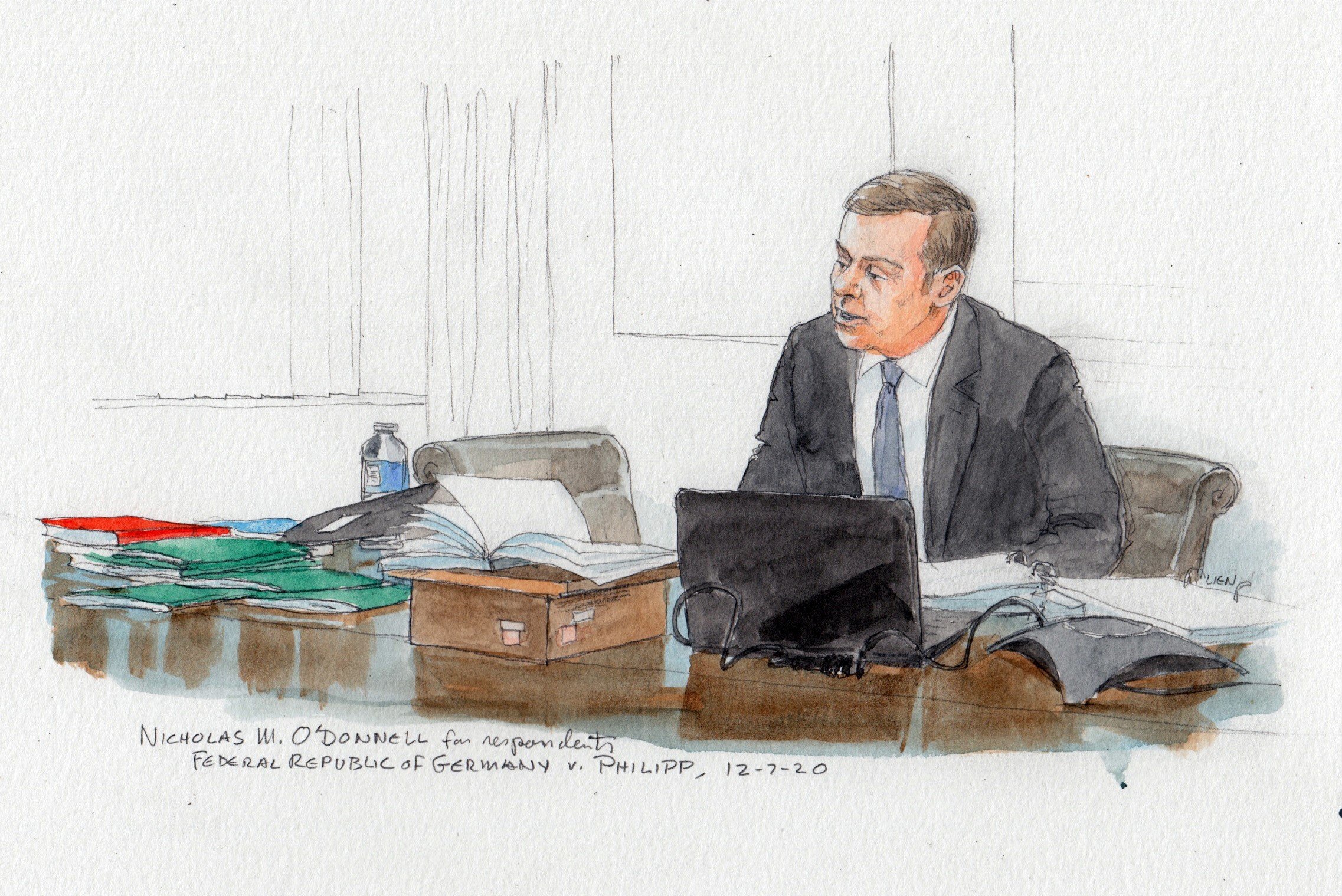
President Donald J. Trump signed the Holocaust Expropriated Art Recovery Act of 2025 into law today, April 13, 2026. The law extends the provisions of the Holocaust Expropriated Art Recovery Act (HEAR Act) of 2016 with respect to the statute of limitations on Nazi-era art recovery claims in U.S. courts, repudiates the Supreme Court’s ruling in F.R.G. v. Philipp, 141 S. Ct. 703 (2021), and prohibits certain other defenses to such claims.
I argued the Philipp case on behalf of the heirs whose ancestors were the consortium of dealers forced to sell the Welfenschatz, or Guelph Treasure, to a cabal of Nazi front men before Hermann Goering presented the collection to Hitler as a gift. Philipp held that Nazi art loss victims from Germany were not the subject of takings in violation of international law because they were “domestic takings” that thus enjoyed sovereign immunity under the Foreign Sovereign Immunities Act (FSIA). The new law is a major development that undercuts the increasingly bad-faith assertion of sovereign immunity against the heirs of Holocaust art theft victims in and since Philipp, and welcome Congressional action for which I advocated in my article last year, “Turnabout is Foul Play: Sovereign Immunity and Cultural Property Claims,” 28 Chap. L. Rev. 553 (2025).
The critical aspects of the law are as follows:
-
It extends the original HEAR Act, which nationalized the statute of limitations for Nazi-era art claims at six years from the actual discovery of the facts and circumstances necessary to bring a claim, subject to certain carveouts for previously-known claims. This replaced constructive knowledge and typical three year limits, which is the standard under most state law statutes of limitations. In contrast to the original HEAR Act’s ten-year sunset provision, the law now has no expiration.
-
It expressly overrules Philipp, which granted sovereign immunity to Germany and its museums by importing a limitation on so-called “domestic takings” never expressed by Congress into the text of the expropriation exception in the FSIA. The result of Philipp was that heirs to the Nazis’ first art theft victims—Jews from Germany—were left without recourse. This law repudiates that ill-reasoned decision (requiring jurisdictional analysis " without regard to the nationality or citizenship of the alleged victim") and vindicates the argument that we made for our clients at the time.
-
The law also rebukes the statements in Philipp that the 2016 HEAR Act—which opened the courthouse doors—was somehow a law primarily directed to out of court solutions, now stating unequivocally: “The intent of this Act is to permit claims to recover Nazi-looted art to be brought.” That should be clear enough.
-
Finally, the law eliminates other potential defenses to Nazi-era claims such as laches, forum non conveniens, international comity abstention, and the Act of State Doctrine, none of which were addressed in the 2016 law. Comity abstention and the Act of State Doctrine in particular have given rise to extraordinary mischief by foreign states seeking to avoid the merits of their illicit possession of Nazi-confiscated art.
Read More
Topics:
Legislation,
laches,
Act of State,
Foreign Sovereign Immunities Act,
FSIA,
expropriation exception”,
NS Raubkunst,
Statute of Limitations,
Federal Republic of Germany,
HEAR Act,
Nazi-confiscated art,
Philipp v. F.R.G.,
domestic takings
Senator Jon Cornyn (R-TX) introduced the Holocaust Expropriated Art Recovery Act of 2025 on May 22, 2025, as Senate Bill 1884, with seven co-sponsors. The bill would extend provisions of the Holocaust Expropriated Art Recovery Act (HEAR Act) of 2016 with respect to the statute of limitations on Nazi-era art recovery claims in U.S. courts, and would rebuke the Supreme Court’s disastrous ruling in 2021 that Nazi art loss victims from Germany were not the subject of takings in violation of international law. The bill is an important step in Holocaust-era art claims and should be passed.
Read More
Topics:
laches,
Act of State,
Statute of Limitations,
Holocaust Expropriated Art Recovery Act,
Richard Blumenthal,
HEAR Act,
Genocide Convention,
Nazi-confiscated art,
F.R.G. v. Philipp,
Marsha Blackburn,
Eric Schmidt,
Katie Boyd Britt,
domestic takings,
Cory Booker,
Thomas Tillis,
Chapman Law Review,
forum non conveniens,
John Fetterman
The Holocaust Expropriated Art Recovery (HEAR) Act of 2016 has been pending for several monthsnow, and was recently recommended favorably by the Senate Judiciary Committee in September. The bill would create a uniform six-year statute of limitations for Nazi-looted art claims, harmonizing an otherwise patchwork state by state system. While that consistency was laudable, our concern was that the bill as proposed would overrule New York’s important demand and refusal approach to statutes of limitations, with the effect that many otherwise timely claims in New York might become barred. The bill’s text has been quietly amended to correct that, and in other interesting ways as well. With the Presidential election just two weeks away, however, it remains anyone’s guess if the bill will become law before the new Congress is seated in January.
Read More
Topics:
Legislation,
Nazi-looted art,
Restitution,
Statute of Limitations,
World War II,
HEAR Act,
demand and refusal
The Senate Judiciary Committee held a hearing this week (video available here) on the Holocaust Art Recovery Act (the “HEAR Act”) that drew welcome attention to the ongoing challenges to the restitution of Nazi-looted art. We were skeptical about the bill’s chances for passage when it was proposed for largely structural reasons: it is the summer before a Presidential election, which is a time when things rarely get done in Washington. Yet it is undeniable that with its bipartisan sponsors Richard Blumenthal, Charles Schumer, Ted Cruz, and John Cornyn—strange political bedfellows under any circumstance—the hearing was an open and constructive discussion that showcased real momentum towards passage. Senator Chuck Grassley’s expediting of the hearing is also a sign that there may be a vote soon. This is important, because recent bills to amend the FSIA as to looted art claims, for example, have never even had a hearing in the Judiciary Committee, let alone gotten a vote (they did pass the House first). Yesterday’s hearing definitely moves the bill into a different category with regard to its prospects. The President has not made any comments on it—yet.
Read More
Topics:
Legislation,
Nazi-looted art,
Restitution,
Statute of Limitations,
Charles Schumer,
John Cornyn,
Richard Blumenthal,
Ted Cruz
The U.S. District Court in Los Angeles has denied yet another motion by the Norton Simon Museum in Pasadena to dismiss claims by Marei von Saher to ownership of the Lucas Cranach paintings Adam and Eve. Ruling on the most recent argument that the claim was brought too late, the court held that the case was within California’s often-revised statute of limitations. Remarkably, even though last year’s remand from the Ninth Circuit raised the question of the application of the Act of State Doctrine, that issue went mentioned but unresolved. That could mean yet another motion before the case can proceed to trial (or even discovery).
Read More
Topics:
Netherlands,
Norton Simon Museum,
Nazi Germany,
Von Saher,
Nazi-looted art,
California Code of Civil Procedure Section 338,
Pasadena,
Adam,
conflict preemption,
Lucas Cranach,
Cranach,
Restitution,
field preemption,
Marei Von Saher,
Statute of Limitations,
Goudstikker,
Los Angeles,
World War II,
Von Saher v. Norton Simon Museum,
Cassirer v. Kingdom of Spain,
Museums,
Eve,
California Code of Civil Procedure 354.3
According to multiple news reports and his attorneys, Cornelius Gurlitt has filed a complaint for the return of the paintings seized in 2012 by the Augsburg prosecutor. Copies are not yet available, but the Gurlitt PR website www.Gurlitt.info" has a release that states as follows (thus far only in German). Stay tuned for developments if and when the document becomes available.
Read More
Topics:
Schwabinger Kunstfund,
Complaint,
Nazi stolen art,
Hannes Hartung,
Hildebrand Gurlitt,
Gurlitt Info,
www.Gurlitt.Info,
Augsburg,
Germany,
Tido Park,
Gurlitt Collection,
Beschwerde,
Entartete Kunst,
Gurlitt Facts,
Beutekunst,
Gurlitt,
Restitution,
Statute of Limitations,
World War II,
Derek Setz,
degenerate art,
Staatsanwalt,
Strafprozessordnung (StPO) Paragraph 304,
Soviet Union,
Raubkunst,
Verjährung,
Münchner Kunstfund
Der Spiegel conducted a face to face interview with Cornelius Gurlitt that was published over the weekend, addressing his intentions about the 1,400 artworks connected to Nazi looting. Most striking was Gurlitt’s declaration with regard to the artworks seized by Bavarian tax authorities “I will give nothing back willingly.” The highlights of the interview, available in both German and English (the fuller version only in print, in German), ranges from discussing Gurlitt’s reclusive existence, to his perceived victimhood, to some standard-fare denialism (like that Hildebrand engaged in the commerce of “degenerate art” nearly always sold under duress or worse only in order to “save” the art).
Read More
Topics:
veschollene Kunst,
Cornelius Gurlitt,
Schwabinger Kunstfund. Kunstfund München,
Verjährungsfrist,
Legal Times,
prescriptive ownership,
Gurlitt Collection,
österreiches Recht,
Bundesgerichtshof,
Hildebrand Gurlit,
Entartete Kunst,
Nazis,
Munich,
Salzburg,
Gurlitt,
Restitution,
City of Gotha et al. v. Sotheby’s et al.,
Statute of Limitations,
Looted Art,
World War II,
deutches Recht,
degenerate art,
Austria,
München,
Raubkunst,
German Civil Code § 221,
Österreich
As discussed earlier in the Art Law Report, the Herzog heirs’ case against several Hungarian national museums survived dismissal (apart from their claims to 11 paintings whose ownership was litigated in Hungary previously). The remaining question was how much of the case would be heard on appeal: only the narrow question of Hungary’s sovereign immunity, or other parts of the decision on the defendants’ motion to dismiss (asserting, in part, that the claims were too old, that the claims were barred as acts of state, and that the United States is not the proper forum).
Read More
Topics:
Hungary,
Restitution,
Statute of Limitations,
World War II,
Foreign Sovereign Immunities
With the recent decision in the Baron Herzog case dismissing some claims but allowing the bulk of the case to go forward, the next step is determining what issues can be appealed now.
Read More
Topics:
Hungary,
Holocaust,
Restitution,
Statute of Limitations,
World War II,
Foreign Sovereign Immunities
The United States District Court has allowed significant parts of the claim brought by claimed heirs of Baron Mor Lipot Herzog to go forward. The decision is significant for several reasons. First, it is the most prominent restitution case currently at the trial level, and the case will now proceed into discovery of the facts. Second, the judge turned away a strong statute of limitations argument, which has been the strong trend in recent restitution cases. On the flip side, the judge found for the defendants on eleven paintings that were the subject of prior litigiation.
Read More
Topics:
Hungary,
Holocaust,
Restitution,
Statute of Limitations,
World War II,
Foreign Sovereign Immunities