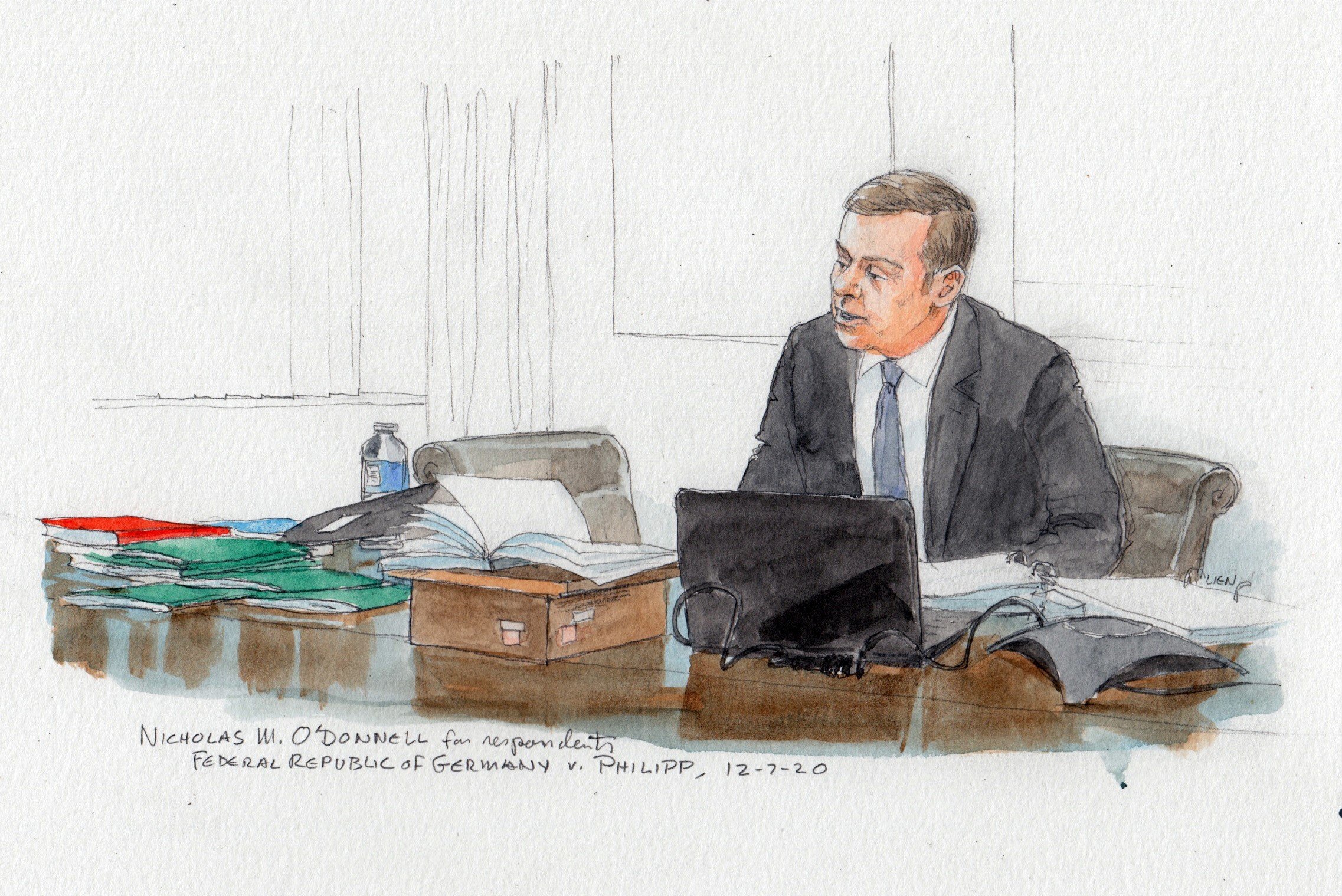
President Donald J. Trump signed the Holocaust Expropriated Art Recovery Act of 2025 into law today, April 13, 2026. The law extends the provisions of the Holocaust Expropriated Art Recovery Act (HEAR Act) of 2016 with respect to the statute of limitations on Nazi-era art recovery claims in U.S. courts, repudiates the Supreme Court’s ruling in F.R.G. v. Philipp, 141 S. Ct. 703 (2021), and prohibits certain other defenses to such claims.
I argued the Philipp case on behalf of the heirs whose ancestors were the consortium of dealers forced to sell the Welfenschatz, or Guelph Treasure, to a cabal of Nazi front men before Hermann Goering presented the collection to Hitler as a gift. Philipp held that Nazi art loss victims from Germany were not the subject of takings in violation of international law because they were “domestic takings” that thus enjoyed sovereign immunity under the Foreign Sovereign Immunities Act (FSIA). The new law is a major development that undercuts the increasingly bad-faith assertion of sovereign immunity against the heirs of Holocaust art theft victims in and since Philipp, and welcome Congressional action for which I advocated in my article last year, “Turnabout is Foul Play: Sovereign Immunity and Cultural Property Claims,” 28 Chap. L. Rev. 553 (2025).
The critical aspects of the law are as follows:
-
It extends the original HEAR Act, which nationalized the statute of limitations for Nazi-era art claims at six years from the actual discovery of the facts and circumstances necessary to bring a claim, subject to certain carveouts for previously-known claims. This replaced constructive knowledge and typical three year limits, which is the standard under most state law statutes of limitations. In contrast to the original HEAR Act’s ten-year sunset provision, the law now has no expiration.
-
It expressly overrules Philipp, which granted sovereign immunity to Germany and its museums by importing a limitation on so-called “domestic takings” never expressed by Congress into the text of the expropriation exception in the FSIA. The result of Philipp was that heirs to the Nazis’ first art theft victims—Jews from Germany—were left without recourse. This law repudiates that ill-reasoned decision (requiring jurisdictional analysis " without regard to the nationality or citizenship of the alleged victim") and vindicates the argument that we made for our clients at the time.
-
The law also rebukes the statements in Philipp that the 2016 HEAR Act—which opened the courthouse doors—was somehow a law primarily directed to out of court solutions, now stating unequivocally: “The intent of this Act is to permit claims to recover Nazi-looted art to be brought.” That should be clear enough.
-
Finally, the law eliminates other potential defenses to Nazi-era claims such as laches, forum non conveniens, international comity abstention, and the Act of State Doctrine, none of which were addressed in the 2016 law. Comity abstention and the Act of State Doctrine in particular have given rise to extraordinary mischief by foreign states seeking to avoid the merits of their illicit possession of Nazi-confiscated art.
Read More
Topics:
Legislation,
laches,
Act of State,
Foreign Sovereign Immunities Act,
FSIA,
expropriation exception”,
NS Raubkunst,
Statute of Limitations,
Federal Republic of Germany,
HEAR Act,
Nazi-confiscated art,
Philipp v. F.R.G.,
domestic takings
I am proud to announce the publication in the Chapman Law Review of my article: “Turnabout is Foul Play: Sovereign Immunity and Cultural Property Claims,” which you can link to here. The abstract of the article is below.
Read More
Topics:
Second Hickenlooper Amendment,
Act of State,
Nazi-looted art,
Foreign Sovereign Immunities Act,
FSIA,
expropriation exception”,
28 U.S.C. § 1605(a)(3),
Genocide Convention,
Nazi-confiscated art,
F.R.G. v. Philipp,
domestic takings,
Chapman Law Review,
Turnabout is Foul Play,
Sovereign Immunity and Cultural Property Claims,
Roberts Court,
Taline Ratanjee,
Greg Mikhanjian,
Anna Ross,
Amber Odell,
Sara Morandi
Senator Jon Cornyn (R-TX) introduced the Holocaust Expropriated Art Recovery Act of 2025 on May 22, 2025, as Senate Bill 1884, with seven co-sponsors. The bill would extend provisions of the Holocaust Expropriated Art Recovery Act (HEAR Act) of 2016 with respect to the statute of limitations on Nazi-era art recovery claims in U.S. courts, and would rebuke the Supreme Court’s disastrous ruling in 2021 that Nazi art loss victims from Germany were not the subject of takings in violation of international law. The bill is an important step in Holocaust-era art claims and should be passed.
Read More
Topics:
laches,
Act of State,
Statute of Limitations,
Holocaust Expropriated Art Recovery Act,
Richard Blumenthal,
HEAR Act,
Genocide Convention,
Nazi-confiscated art,
F.R.G. v. Philipp,
Marsha Blackburn,
Eric Schmidt,
Katie Boyd Britt,
domestic takings,
Cory Booker,
Thomas Tillis,
Chapman Law Review,
forum non conveniens,
John Fetterman
I was proud to advise the Allentown Art Museum, which announced today that it has reached an agreement with the heirs of Henry and Hertha Bromberg concerning Portrait of George, Duke of Saxony by Lucas Cranach the Elder and his workshop. Pursuant to the agreement, the painting will be auctioned at Christie’s in New York next year following educational programming focusing on the painting’s history. The Museum’s press release can be read here. The story was also addressed in an excellent article in The New York Times by Graham Bowley.
(Portrait of George the Bearded, Duke of Saxony, by Lucas Cranach the Elder and workshop)
Read More
Topics:
Graham Bowley,
Paris,
Washington Conference Principles,
Christie's,
Hamburg,
Lucas Cranach the Elder,
The New York Times,
Nazi-confiscated art,
Henry Bromberg,
Hertha Bromberg,
Martin Bromberg,
Max Weintraub,
Reichsfluchtsteuer,
Allen Loebl,
F. Kleinberger Gallery,
property inventory,
Allentown Art Museum,
Portrait of George the Bearded Duke of Saxony,
Porträt des Georg dem Bärtigen Herzog von Sachsen,
Vermögensverzeichnis,
Wildenstein
I was pleased for the opportunity to chat with Larry Perel of KCRW in Santa Barbara about the significance of the recent ruling that the Thyssen-Bornemisza Museum in Madrid is the owner of Rue St. Honoré, effet de pluie by Camille Pissarro—notwithstanding that there was no dispute that it had been looted from the Cassirer by the Nazis. You can listen to the full audio of the radio broadcast here. I discussed the Cassirer case, the more recent decision by the United States Supreme Court not to hear further appeal of Marei von Saher’s lawsuit against the Norton Simon Museum, and other current issues concerning the restitution of Nazi-confiscated art claims. You can read more background on these cases here at the Art Law Report, or in A Tragic Fate—Law and Ethics in the Battle Over Nazi-Looted Art.
Read More
Topics:
Nazi-looted art,
Marei Von Saher,
Camille Pissarro,
Art Law Report,
A Tragic Fate,
Thyssen-Bornemisza Museum,
Rue St. Honoré effet de pluie,
Nazi-confiscated art,
Larry Perel,
KCRW,
Santa Barbara,
Madrid