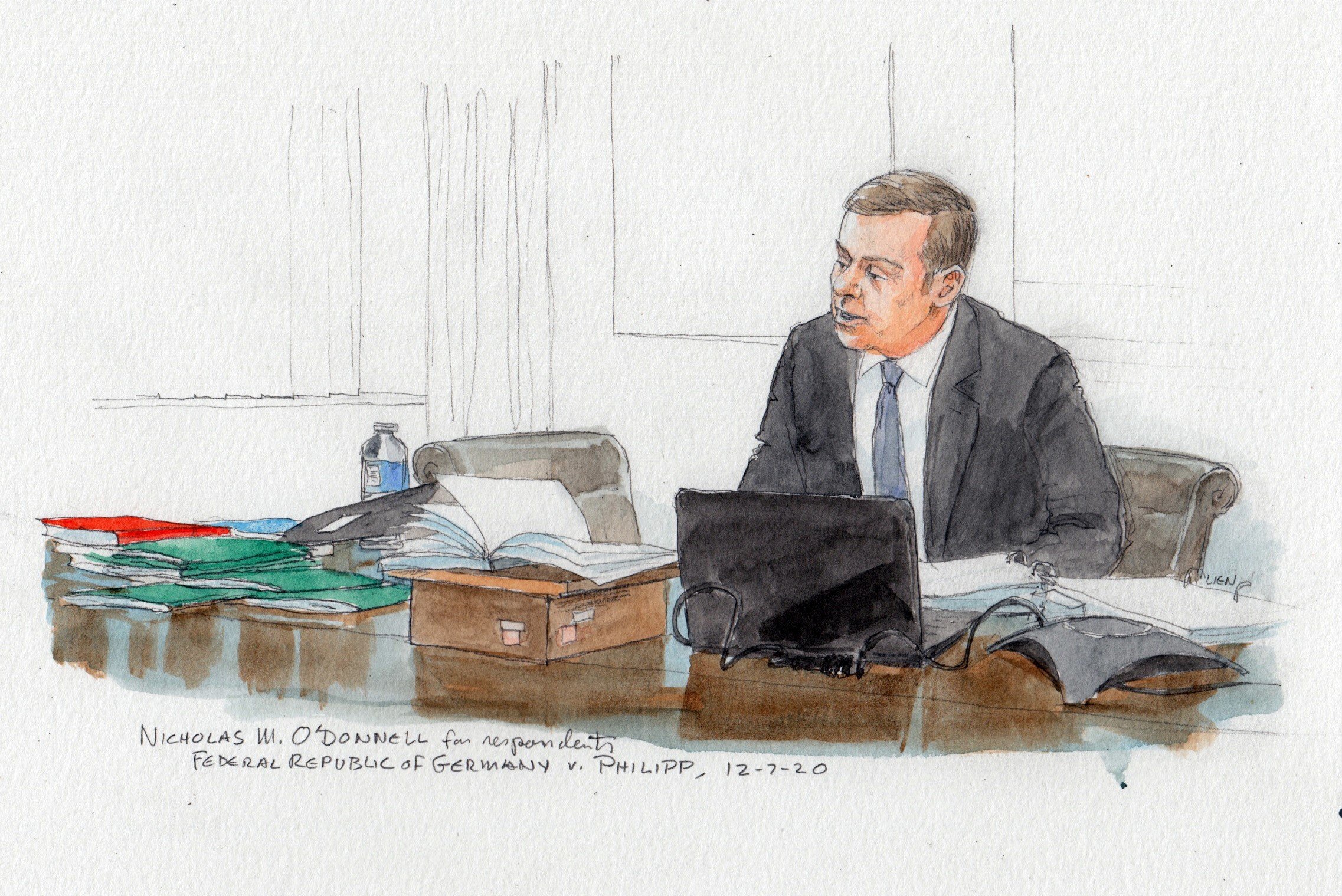
President Donald J. Trump signed the Holocaust Expropriated Art Recovery Act of 2025 into law today, April 13, 2026. The law extends the provisions of the Holocaust Expropriated Art Recovery Act (HEAR Act) of 2016 with respect to the statute of limitations on Nazi-era art recovery claims in U.S. courts, repudiates the Supreme Court’s ruling in F.R.G. v. Philipp, 141 S. Ct. 703 (2021), and prohibits certain other defenses to such claims.
I argued the Philipp case on behalf of the heirs whose ancestors were the consortium of dealers forced to sell the Welfenschatz, or Guelph Treasure, to a cabal of Nazi front men before Hermann Goering presented the collection to Hitler as a gift. Philipp held that Nazi art loss victims from Germany were not the subject of takings in violation of international law because they were “domestic takings” that thus enjoyed sovereign immunity under the Foreign Sovereign Immunities Act (FSIA). The new law is a major development that undercuts the increasingly bad-faith assertion of sovereign immunity against the heirs of Holocaust art theft victims in and since Philipp, and welcome Congressional action for which I advocated in my article last year, “Turnabout is Foul Play: Sovereign Immunity and Cultural Property Claims,” 28 Chap. L. Rev. 553 (2025).
The critical aspects of the law are as follows:
-
It extends the original HEAR Act, which nationalized the statute of limitations for Nazi-era art claims at six years from the actual discovery of the facts and circumstances necessary to bring a claim, subject to certain carveouts for previously-known claims. This replaced constructive knowledge and typical three year limits, which is the standard under most state law statutes of limitations. In contrast to the original HEAR Act’s ten-year sunset provision, the law now has no expiration.
-
It expressly overrules Philipp, which granted sovereign immunity to Germany and its museums by importing a limitation on so-called “domestic takings” never expressed by Congress into the text of the expropriation exception in the FSIA. The result of Philipp was that heirs to the Nazis’ first art theft victims—Jews from Germany—were left without recourse. This law repudiates that ill-reasoned decision (requiring jurisdictional analysis " without regard to the nationality or citizenship of the alleged victim") and vindicates the argument that we made for our clients at the time.
-
The law also rebukes the statements in Philipp that the 2016 HEAR Act—which opened the courthouse doors—was somehow a law primarily directed to out of court solutions, now stating unequivocally: “The intent of this Act is to permit claims to recover Nazi-looted art to be brought.” That should be clear enough.
-
Finally, the law eliminates other potential defenses to Nazi-era claims such as laches, forum non conveniens, international comity abstention, and the Act of State Doctrine, none of which were addressed in the 2016 law. Comity abstention and the Act of State Doctrine in particular have given rise to extraordinary mischief by foreign states seeking to avoid the merits of their illicit possession of Nazi-confiscated art.
Read More
Topics:
Legislation,
laches,
Act of State,
Foreign Sovereign Immunities Act,
FSIA,
expropriation exception”,
NS Raubkunst,
Statute of Limitations,
Federal Republic of Germany,
HEAR Act,
Nazi-confiscated art,
Philipp v. F.R.G.,
domestic takings
I am proud to announce the publication in the Chapman Law Review of my article: “Turnabout is Foul Play: Sovereign Immunity and Cultural Property Claims,” which you can link to here. The abstract of the article is below.
Read More
Topics:
Second Hickenlooper Amendment,
Act of State,
Nazi-looted art,
Foreign Sovereign Immunities Act,
FSIA,
expropriation exception”,
28 U.S.C. § 1605(a)(3),
Genocide Convention,
Nazi-confiscated art,
F.R.G. v. Philipp,
domestic takings,
Chapman Law Review,
Turnabout is Foul Play,
Sovereign Immunity and Cultural Property Claims,
Roberts Court,
Taline Ratanjee,
Greg Mikhanjian,
Anna Ross,
Amber Odell,
Sara Morandi
Senator Jon Cornyn (R-TX) introduced the Holocaust Expropriated Art Recovery Act of 2025 on May 22, 2025, as Senate Bill 1884, with seven co-sponsors. The bill would extend provisions of the Holocaust Expropriated Art Recovery Act (HEAR Act) of 2016 with respect to the statute of limitations on Nazi-era art recovery claims in U.S. courts, and would rebuke the Supreme Court’s disastrous ruling in 2021 that Nazi art loss victims from Germany were not the subject of takings in violation of international law. The bill is an important step in Holocaust-era art claims and should be passed.
Read More
Topics:
laches,
Act of State,
Statute of Limitations,
Holocaust Expropriated Art Recovery Act,
Richard Blumenthal,
HEAR Act,
Genocide Convention,
Nazi-confiscated art,
F.R.G. v. Philipp,
Marsha Blackburn,
Eric Schmidt,
Katie Boyd Britt,
domestic takings,
Cory Booker,
Thomas Tillis,
Chapman Law Review,
forum non conveniens,
John Fetterman

The U.S. Court of Appeals for the Ninth Circuit has upheld the judgment against Marei von Saher on her claims against the Norton Simon Museum in Pasadena to recover Adam and Eve by Lucas Cranach the Elder. The Cranachs belonged to Von Saher’s father-in-law Jacques Goudstikker, a renowned Dutch Jewish art dealer who fled the Netherlands. Yesterday’s decision was the latest in a complicated case, holding that the claim could not proceed because it would conflict with a judgment made by the Dutch government—in a case about paintings that no one disputes were looted by the Nazis but which the Norton Simon refuses to return. Notably, the Ninth Circuit upheld the dismissal entered two years ago by the District Court, but for different reasons. Where the trial court had held in 2016 that Von Saher was not entitled to the paintings by applying substantive Dutch post-war law, the Ninth Circuit yesterday held that it could not entertain the question because it involved a so-called “Act of State,” a doctrine under which courts will decline to review certain kinds of cases that implicate sovereign acts. It was not a complete surprise—the appeals court had hinted at the possibility of applying the doctrine back in 2014 when it remanded the case on one of its multiple trips to the appellate court—but was a curious application of it to a sale by the Dutch government, an act that is quintessentially commercial, not sovereign. It remains to be seen what Von Saher will do next. Von Saher is a complicated dispute that deserved its day in court, not the back of the hand out of “respect” for an “official” act that never actually happened, or an official act that this most recent decision actually contradicts.
Read More
Topics:
Alois Miedl,
Act of State,
Jacques Goudstikker,
Nazi-looted art,
Hermann Goering,
Restitution,
Marei Von Saher,
Ninth Circuit,
HEAR Act,
A Tragic Fate,
George Stroganoff,
Commisssie Rechtsverkeer in oorlogstijd,
Royal Decree 133,
Royal Decree A6,
CORVO,
Royal Decree 100
One of the issues exposed and exacerbated by the ongoing Gurlitt collection stalemate is the question of Germany’s restitution procedures with respect to art. As the Bavarian legislative proposal to abolish the statute of limitations for claims against bad-faith acquirers is considered by the Bundestag, the “German Advisory Commission for the Return of Cultural Property Seized as a Result of Nazi Persecution, Especially Jewish Property” has issued a decision over what has become known as the “Guelph Treasure” (Welfenschatz) in the collection of the Stiftung Preussischer Kulturbesitz (SPK), the Prussian Cultural Heritage Foundation. The March 20, 2014 opinion (available, so far as I know, only in German at this point at www.lostart.de) underscores the issues around claims of sales under duress, and the appropriate present-day procedural remedy. Readers should also brush up on their medieval German history to keep up.
Read More
Topics:
Holy Roman Emperor Otto IV,
German Supreme Commercial Court,
Holy Roman Empire,
Bundeshandelsgericht,
German Supreme Constitutional Court,
Z.M. Hackenbroch,
Karl Blechen,
Duchy of Brunswick and Lüneburg,
Niedersachsen,
Karl Ernst Baumann,
Act of State,
Kingdom of Hanover. Königreich Hannover,
Dr Alexander Lewin,
Prussia,
Lower Saxony,
Anselm Feuerbach,
Gurlitt Collection,
Foreign Sovereign Immunities Act,
Preussen,
Hans Sachs,
German Advisory Commission for the Return of Cultu,
Hessen,
Fogg Art Museum,
Congress of Vienna,
Julius and Clara Freund,
Kurhannover,
Dresdner Bank,
Hermann Goring,
Austrian Supreme Court,
Johann J. August von der Embde,
House of Welf,
Stiftung Preussischer Kulturbesitz,
Wilhelm Leibl,
Portrait of Amalie Zuckerkandl,
Braunschweig-Lüneburg,
Harvard,
Portrait der Familie von Dithfurth,
Gurlitt,
Restitution,
George I,
J.S. Goldschmidt,
World War II,
Peasant Girl without a Hat and with a White Headcl,
Queen Victoria,
Prussian Cultural Heritage Foundation,
Art Institute of Chicago,
Kurfürsten,
Jutta Limbach,
www.lostart.de,
Soviet Union,
Gustav Klimt,
Bundesverfassungsgericht,
Welfenschatz,
Limbach Commission,
I. Rosenbaum,
Electors