Art Law Report Header-1

Holocaust Expropriated Art Recovery Act of 2025 Signed Into Law, Rebukes Supreme Court Ruling on Sovereign Immunity for Nazi-era Art Claims

Posted by Nicholas O'Donnell on April 13, 2026 at 6:13 PM

President Donald J. Trump signed the Holocaust Expropriated Art Recovery Act of 2025 into law today, April 13, 2026. The law extends the provisions of the Holocaust Expropriated Art Recovery Act (HEAR Act) of 2016 with respect to the statute of limitations on Nazi-era art recovery claims in U.S. courts, repudiates the Supreme Court’s ruling in F.R.G. v. Philipp, 141 S. Ct. 703 (2021), and prohibits certain other defenses to such claims.

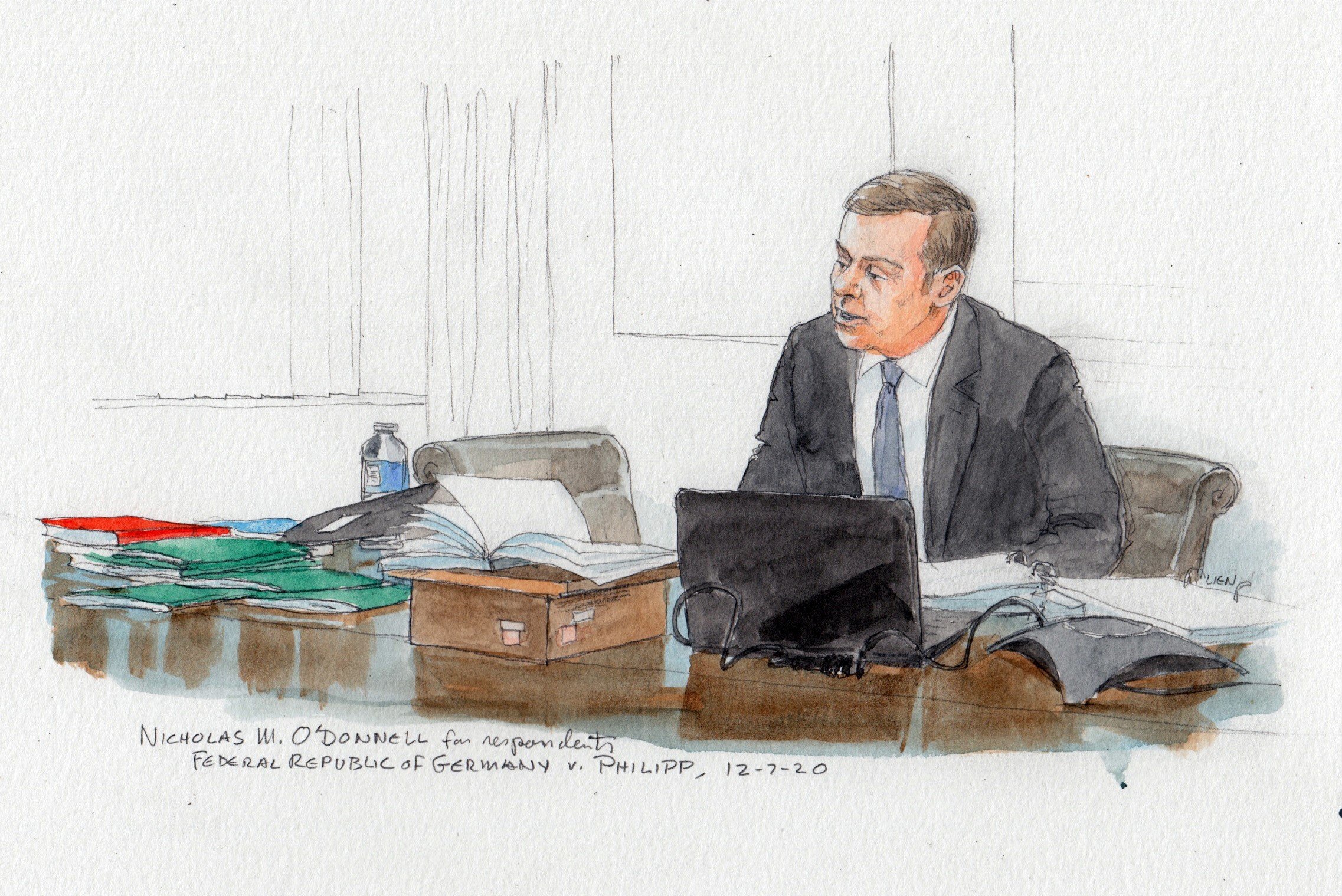
I argued the Philipp case on behalf of the heirs whose ancestors were the consortium of dealers forced to sell the Welfenschatz, or Guelph Treasure, to a cabal of Nazi front men before Hermann Goering presented the collection to Hitler as a gift. Philipp held that Nazi art loss victims from Germany were not the subject of takings in violation of international law because they were “domestic takings” that thus enjoyed sovereign immunity under the Foreign Sovereign Immunities Act (FSIA). The new law is a major development that undercuts the increasingly bad-faith assertion of sovereign immunity against the heirs of Holocaust art theft victims in and since Philipp, and welcome Congressional action for which I advocated in my article last year, “Turnabout is Foul Play: Sovereign Immunity and Cultural Property Claims,” 28 Chap. L. Rev. 553 (2025).

The critical aspects of the law are as follows:

  • It extends the original HEAR Act, which nationalized the statute of limitations for Nazi-era art claims at six years from the actual discovery of the facts and circumstances necessary to bring a claim, subject to certain carveouts for previously-known claims. This replaced constructive knowledge and typical three year limits, which is the standard under most state law statutes of limitations. In contrast to the original HEAR Act’s ten-year sunset provision, the law now has no expiration.
  • It expressly overrules Philipp, which granted sovereign immunity to Germany and its museums by importing a limitation on so-called “domestic takings” never expressed by Congress into the text of the expropriation exception in the FSIA. The result of Philipp was that heirs to the Nazis’ first art theft victims—Jews from Germany—were left without recourse. This law repudiates that ill-reasoned decision (requiring jurisdictional analysis " without regard to the nationality or citizenship of the alleged victim") and vindicates the argument that we made for our clients at the time.
  • The law also rebukes the statements in Philipp that the 2016 HEAR Act—which opened the courthouse doors—was somehow a law primarily directed to out of court solutions, now stating unequivocally: “The intent of this Act is to permit claims to recover Nazi-looted art to be brought.” That should be clear enough.
  • Finally, the law eliminates other potential defenses to Nazi-era claims such as laches, forum non conveniens, international comity abstention, and the Act of State Doctrine, none of which were addressed in the 2016 law. Comity abstention and the Act of State Doctrine in particular have given rise to extraordinary mischief by foreign states seeking to avoid the merits of their illicit possession of Nazi-confiscated art.

 

Read More

Topics: Legislation, laches, Act of State, Foreign Sovereign Immunities Act, FSIA, expropriation exception”, NS Raubkunst, Statute of Limitations, Federal Republic of Germany, HEAR Act, Nazi-confiscated art, Philipp v. F.R.G., domestic takings

Sullivan Files Supreme Court Amicus Brief with former State Department Legal Adviser in Nazi-looted Art Case

Posted by Nicholas O'Donnell on November 22, 2021 at 5:43 PM

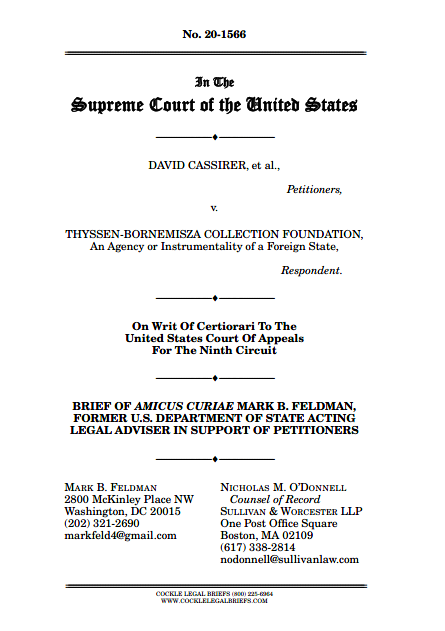
Today I am pleased to announce that I have filed a brief in the Supreme Court of the United States as counsel of record for amicus curiae Mark B. Feldman, former U.S. Department of State Acting Legal Adviser. We filed the brief in the case of Cassirer et al. v. Thyssen-Bornemisza Collection Foundation (“TBC”). Cassirer is the long-running dispute over title to Rue St. Honoré, après-midi, effet de pluie (Rue St. Honoré, Afternoon, Rain Effect) by Impressionist painter Camille Pissarro. The painting once belonged to Lilly Cassirer, a Jewish woman in Berlin in 1939, from whom Nazi agents “bought” the painting. The case before the Supreme Court is not about whether the painting was stolen—it is undisputed that it was. Rather, the Supreme Court will review the Ninth Circuit’s decision that Spanish law, not California law, should govern the ownership rights.

Read More

Topics: Lilly Cassirer, Foreign Sovereign Immunities Act, Supreme Court, SPK, Stiftung Preussischer Kulturbesitz, Hermann Goering, FSIA, expropriation exception”, sovereign immunity, UNESCO, Rue St. Honoré, Camille Pissarro, Baron Hans-Heinrich Thyssen- Bornemisza, Cassirer v. Thyssen-Bornemisza Collection, Welfenschatz, Jakob Scheidwimmer, Philipp v. F.R.G., Mark B. Feldman

Heirs of Holocaust Victim Fritz Grünbaum Win Restitution of Nazi-Looted Schiele Drawings

Posted by Nicholas O'Donnell on July 11, 2019 at 5:05 PM

The Appellate Division First Department in New York has affirmed the trial court’s ruling in Reif v. Nagy that the heirs of Viennese actor and Holocaust victim Franz Friedrich (Fritz) Grünbaum are entitled to the return of two Egon Schiele drawings, Woman Hiding her Face (1912) and Woman in a Black Pinafore (1911).  The ruling is a momentous victory for the Grünbaum heirs, and features several recurring characters in many Nazi-looted restitution disputes.  We were doubly gratified to see the First Department’s citation to our own case, Philipp v. F.R.G., 894 F.3d 406 (D.C. Cir. 2018) for the proposition that sales under duress are void and violate international law consistent with the policies of the Holocaust Expropriated Art Recovery (HEAR) Act of 2016.  It is a landmark ruling and a testament to the perseverance of the Grünbaum heirs and their legal team.

Read More

Topics: Cornelius Gurlitt, Galerie St. Etienne, Nazi-looted art, Foreign Sovereign Immunities Act, Galerie Gutekunst, Holocaust, Fritz Grünbaum, NS Raubkunst, Egon Schiele, Mathilde Lukacs, Franz Kieslinger, Anschluss, Welfenschatz, HEAR Act, Ankerwycke, A Tragic Fate, Law and Ethics in the Battle Over Nazi-Looted Art, Holocaust Expropriated Art Recovery Act of 2016, Woman in a Black Pinafore, Woman Hiding her Face, Seated Woman With Bent Left Leg (Torso), Reif v. Nagy, D.C. Circuit Court of Appeals, Eberhard Kornfeld, Philipp v. F.R.G., New York Law Journal, Gutekunst & Klipstein, Jonathan Petropoulos

Sullivan logo

About the Blog


The Art Law Report provides timely updates and commentary on legal issues in the museum and visual arts communities. It is authored by Nicholas M. O'Donnell, partner in our Art & Museum Law Practice.

The material on this site is for general information only and is not legal advice. No liability is accepted for any loss or damage which may result from reliance on it. Always consult a qualified lawyer about a specific legal problem.

Meet the Editor

Recent Posts

Posts by Topic

see all