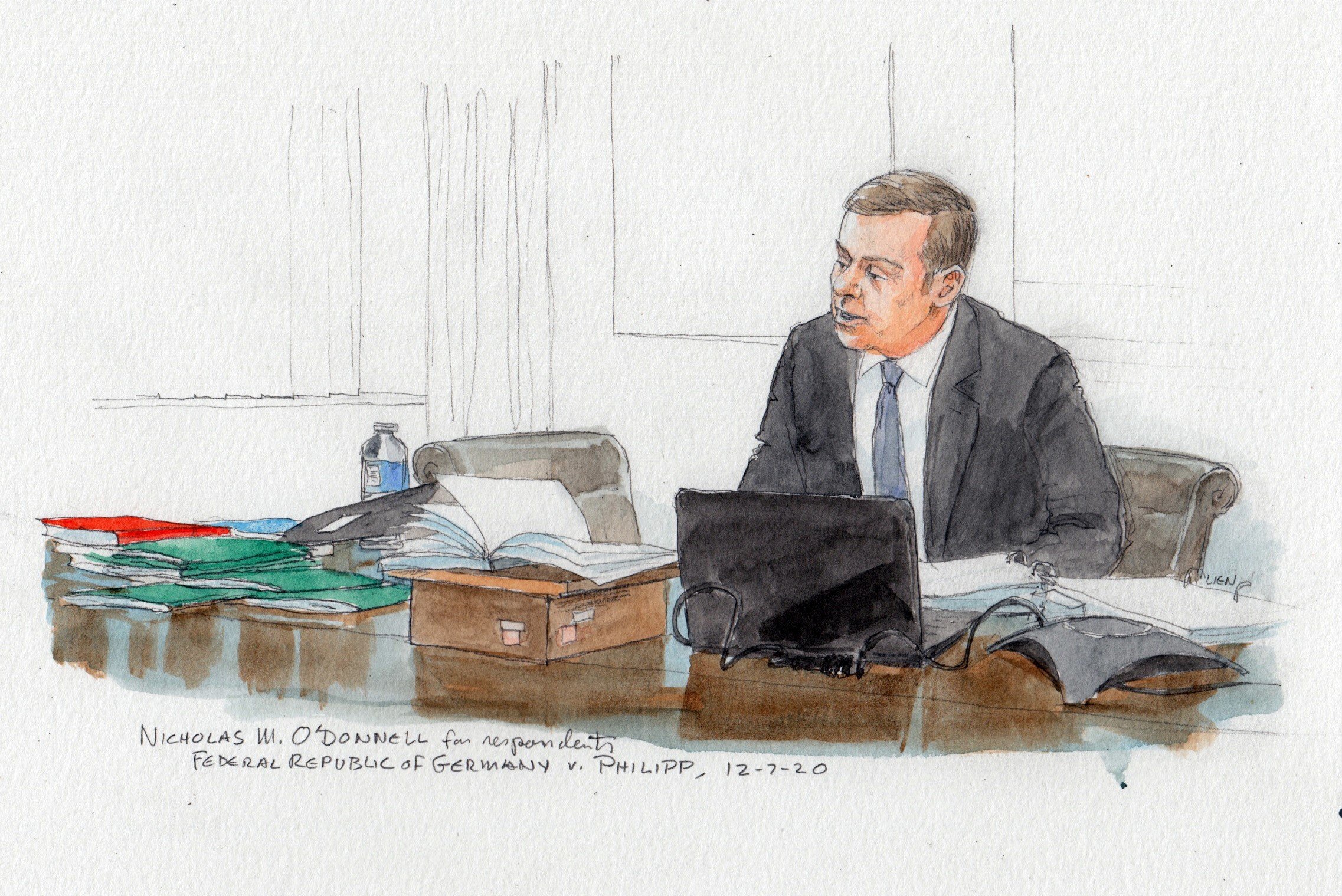
President Donald J. Trump signed the Holocaust Expropriated Art Recovery Act of 2025 into law today, April 13, 2026. The law extends the provisions of the Holocaust Expropriated Art Recovery Act (HEAR Act) of 2016 with respect to the statute of limitations on Nazi-era art recovery claims in U.S. courts, repudiates the Supreme Court’s ruling in F.R.G. v. Philipp, 141 S. Ct. 703 (2021), and prohibits certain other defenses to such claims.
I argued the Philipp case on behalf of the heirs whose ancestors were the consortium of dealers forced to sell the Welfenschatz, or Guelph Treasure, to a cabal of Nazi front men before Hermann Goering presented the collection to Hitler as a gift. Philipp held that Nazi art loss victims from Germany were not the subject of takings in violation of international law because they were “domestic takings” that thus enjoyed sovereign immunity under the Foreign Sovereign Immunities Act (FSIA). The new law is a major development that undercuts the increasingly bad-faith assertion of sovereign immunity against the heirs of Holocaust art theft victims in and since Philipp, and welcome Congressional action for which I advocated in my article last year, “Turnabout is Foul Play: Sovereign Immunity and Cultural Property Claims,” 28 Chap. L. Rev. 553 (2025).
The critical aspects of the law are as follows:
- It extends the original HEAR Act, which nationalized the statute of limitations for Nazi-era art claims at six years from the actual discovery of the facts and circumstances necessary to bring a claim, subject to certain carveouts for previously-known claims. This replaced constructive knowledge and typical three year limits, which is the standard under most state law statutes of limitations. In contrast to the original HEAR Act’s ten-year sunset provision, the law now has no expiration.
- It expressly overrules Philipp, which granted sovereign immunity to Germany and its museums by importing a limitation on so-called “domestic takings” never expressed by Congress into the text of the expropriation exception in the FSIA. The result of Philipp was that heirs to the Nazis’ first art theft victims—Jews from Germany—were left without recourse. This law repudiates that ill-reasoned decision (requiring jurisdictional analysis " without regard to the nationality or citizenship of the alleged victim") and vindicates the argument that we made for our clients at the time.
- The law also rebukes the statements in Philipp that the 2016 HEAR Act—which opened the courthouse doors—was somehow a law primarily directed to out of court solutions, now stating unequivocally: “The intent of this Act is to permit claims to recover Nazi-looted art to be brought.” That should be clear enough.
-
Finally, the law eliminates other potential defenses to Nazi-era claims such as laches, forum non conveniens, international comity abstention, and the Act of State Doctrine, none of which were addressed in the 2016 law. Comity abstention and the Act of State Doctrine in particular have given rise to extraordinary mischief by foreign states seeking to avoid the merits of their illicit possession of Nazi-confiscated art.