President Donald J. Trump signed the Holocaust Expropriated Art Recovery Act of 2025 into law today, April 13, 2026. The law extends the provisions of the Holocaust Expropriated Art Recovery Act (HEAR Act) of 2016 with respect to the statute of limitations on Nazi-era art recovery claims in U.S. courts, repudiates the Supreme Court’s ruling in F.R.G. v. Philipp, 141 S. Ct. 703 (2021), and prohibits certain other defenses to such claims.
I argued the Philipp case on behalf of the heirs whose ancestors were the consortium of dealers forced to sell the Welfenschatz, or Guelph Treasure, to a cabal of Nazi front men before Hermann Goering presented the collection to Hitler as a gift. Philipp held that Nazi art loss victims from Germany were not the subject of takings in violation of international law because they were “domestic takings” that thus enjoyed sovereign immunity under the Foreign Sovereign Immunities Act (FSIA). The new law is a major development that undercuts the increasingly bad-faith assertion of sovereign immunity against the heirs of Holocaust art theft victims in and since Philipp, and welcome Congressional action for which I advocated in my article last year, “Turnabout is Foul Play: Sovereign Immunity and Cultural Property Claims,” 28 Chap. L. Rev. 553 (2025).
The critical aspects of the law are as follows:
-
It extends the original HEAR Act, which nationalized the statute of limitations for Nazi-era art claims at six years from the actual discovery of the facts and circumstances necessary to bring a claim, subject to certain carveouts for previously-known claims. This replaced constructive knowledge and typical three year limits, which is the standard under most state law statutes of limitations. In contrast to the original HEAR Act’s ten-year sunset provision, the law now has no expiration.
-
It expressly overrules Philipp, which granted sovereign immunity to Germany and its museums by importing a limitation on so-called “domestic takings” never expressed by Congress into the text of the expropriation exception in the FSIA. The result of Philipp was that heirs to the Nazis’ first art theft victims—Jews from Germany—were left without recourse. This law repudiates that ill-reasoned decision (requiring jurisdictional analysis " without regard to the nationality or citizenship of the alleged victim") and vindicates the argument that we made for our clients at the time.
-
The law also rebukes the statements in Philipp that the 2016 HEAR Act—which opened the courthouse doors—was somehow a law primarily directed to out of court solutions, now stating unequivocally: “The intent of this Act is to permit claims to recover Nazi-looted art to be brought.” That should be clear enough.
-
Finally, the law eliminates other potential defenses to Nazi-era claims such as laches, forum non conveniens, international comity abstention, and the Act of State Doctrine, none of which were addressed in the 2016 law. Comity abstention and the Act of State Doctrine in particular have given rise to extraordinary mischief by foreign states seeking to avoid the merits of their illicit possession of Nazi-confiscated art.
Read More
Topics:
Legislation,
laches,
Act of State,
Foreign Sovereign Immunities Act,
FSIA,
expropriation exception”,
NS Raubkunst,
Statute of Limitations,
Federal Republic of Germany,
HEAR Act,
Nazi-confiscated art,
Philipp v. F.R.G.,
domestic takings
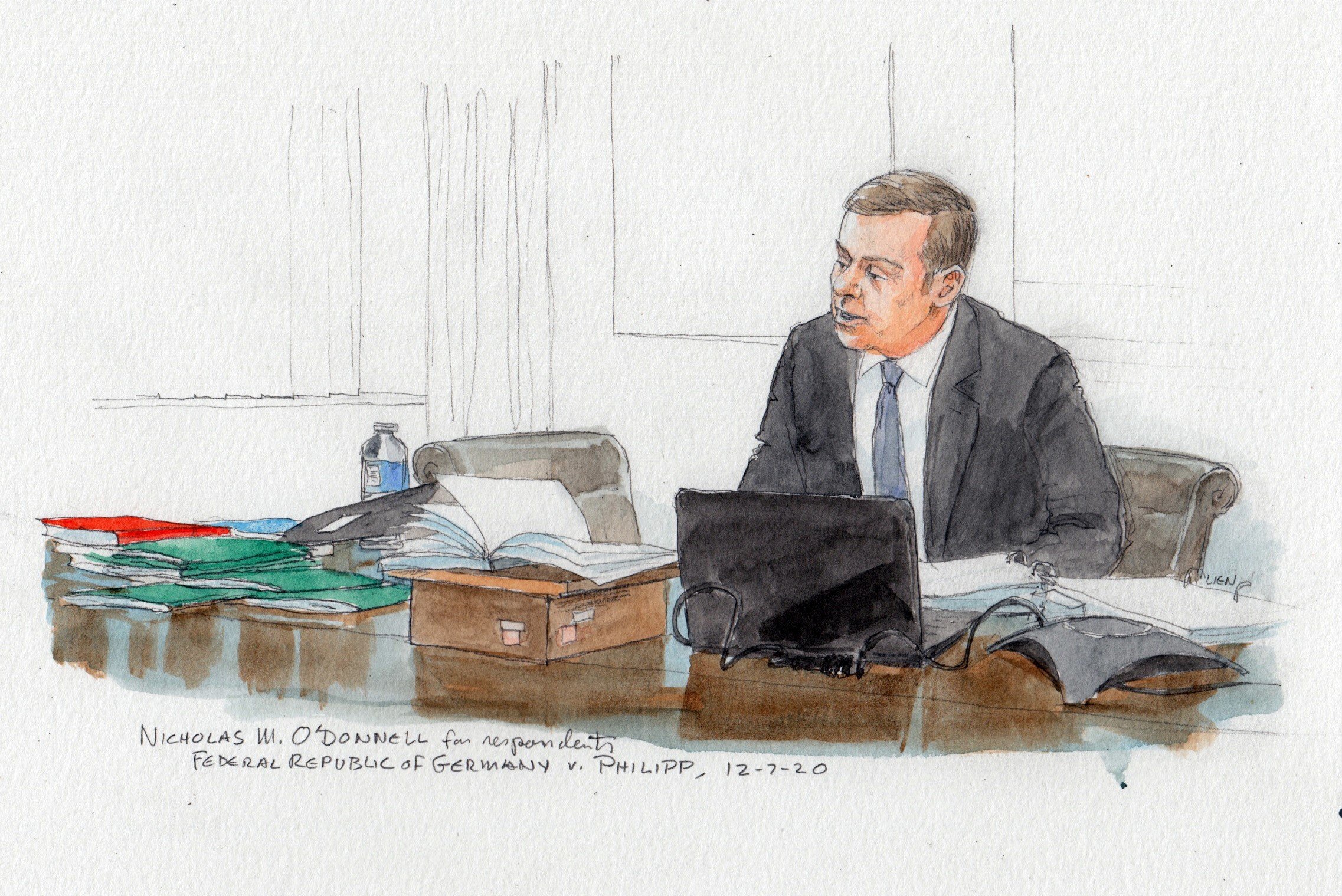
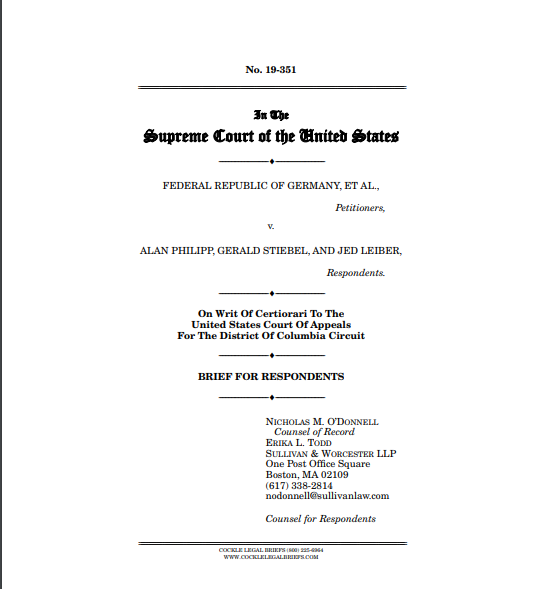
(WASHINGTON-October 22, 2020) The heirs to the Jewish art dealers who were forced to sell the medieval devotional art collection known as the Welfenschatz (in English, the Guelph Treasure) to agents of Hermann Goering in 1935 filed their brief today in the Supreme Court of the United States. It can be viewed at this link. The Supreme Court is set to hear argument on December 7, 2020, on whether the Foreign Sovereign Immunities Act (FSIA) and its “takings clause” create jurisdiction over the heirs’ claims for restitution of the Welfenschatz—as all reviewing courts so far have held. The Welfenschatz is held by the Stiftung Preussischer Kulturbesitz (in English, the Prussian Cultural Heritage Foundation).
Read More
Topics:
Third Reich,
Gestapo,
Z.M. Hackenbroch,
Prussia,
Germany,
Nazi-looted art,
Foreign Sovereign Immunities Act,
Markus Stoetzel,
Supreme Court,
Mel Urbach,
SPK,
Nuremberg race laws,
Stiftung Preussischer Kulturbesitz,
Hermann Goering,
FSIA,
NS Raubkunst,
Sullivan & Worcester LLP,
J.S. Goldschmidt,
Gerald Stiebel,
Prussian Cultural Heritage Foundation,
Adolf Hitler,
Nicholas M. O'Donnell,
Alan Philipp,
Welfenschatz,
I. Rosenbaum,
Paul Körner,
Wannsee Conference,
Jed Leiber,
House of Brunswick (Braunschweig)-Lüneberg,
Emily Haber,
Wilhelm Stuckart,
Final Solution
(WASHINGTON-July 2, 2020) The United States Supreme Court today agreed to hear the appeal by Germany and the Stiftung Preussischer Kulturbesitz (SPK) seeking to dismiss the restitution claim by the heirs to the so-called Guelph Treasure (known in German as the Welfenschatz). The claims arise out of the forced transfer in 1935 of the Guelph Treasure by a consortium of Jewish art dealers to agents of Hermann Goering, who personally presented it as a gift to Hitler. In 2018, the Court of Appeals for the D.C. Circuit held that U.S. courts have jurisdiction over the claim under the Foreign Sovereign Immunities Act of 1976 (FSIA). That appellate court had rejected the Defendants’ arguments that U.S. courts lack jurisdiction, and that Germany’s treatment of its Jews in the 1930s should be immune from judicial scrutiny.
Sullivan partner Nicholas M. O’Donnell said, “we are grateful for the opportunity to address the Supreme Court on these important questions about holding Germany accountable for its Nazi-looted art. A 1935 transfer from German Jews to notorious art looter and war criminal Hermann Goering is the quintessential crime against international law, regardless of Germany’s Holocaust distortion in defending this case. Germany seeks to eliminate recourse for Nazi-looted art and the Court will have the chance to answer this question of critical importance for Holocaust victims.” O’Donnell added, “this is also an opportunity to rebuke the Department of Justice and State Department, who turned their back on decades of U.S. policy by siding with Germany’s effort to keep Nazi-looted art.”
Read More
Topics:
United States Supreme Court,
Nazi-looted art,
Department of Justice,
SPK,
Stiftung Preussischer Kulturbesitz,
Hermann Goering,
NS Raubkunst,
Gerald Stiebel,
Prussian Cultural Heritage Foundation,
Federal Republic of Germany,
Alan Philipp,
Welfenschatz,
State Department,
Paul Körner,
Jed Leiber
The Appellate Division First Department in New York has affirmed the trial court’s ruling in Reif v. Nagy that the heirs of Viennese actor and Holocaust victim Franz Friedrich (Fritz) Grünbaum are entitled to the return of two Egon Schiele drawings, Woman Hiding her Face (1912) and Woman in a Black Pinafore (1911). The ruling is a momentous victory for the Grünbaum heirs, and features several recurring characters in many Nazi-looted restitution disputes. We were doubly gratified to see the First Department’s citation to our own case, Philipp v. F.R.G., 894 F.3d 406 (D.C. Cir. 2018) for the proposition that sales under duress are void and violate international law consistent with the policies of the Holocaust Expropriated Art Recovery (HEAR) Act of 2016. It is a landmark ruling and a testament to the perseverance of the Grünbaum heirs and their legal team.
Read More
Topics:
Cornelius Gurlitt,
Galerie St. Etienne,
Nazi-looted art,
Foreign Sovereign Immunities Act,
Galerie Gutekunst,
Holocaust,
Fritz Grünbaum,
NS Raubkunst,
Egon Schiele,
Mathilde Lukacs,
Franz Kieslinger,
Anschluss,
Welfenschatz,
HEAR Act,
Ankerwycke,
A Tragic Fate,
Law and Ethics in the Battle Over Nazi-Looted Art,
Holocaust Expropriated Art Recovery Act of 2016,
Woman in a Black Pinafore,
Woman Hiding her Face,
Seated Woman With Bent Left Leg (Torso),
Reif v. Nagy,
D.C. Circuit Court of Appeals,
Eberhard Kornfeld,
Philipp v. F.R.G.,
New York Law Journal,
Gutekunst & Klipstein,
Jonathan Petropoulos
The U.S. Court of Appeals for the D.C. Circuit today dismissed the petition to rehear en banc last year’s landmark ruling that the heirs of the art dealers who sold the Guelph Treasure (or Welfenschatz) may pursue their claims in U.S. federal court. Defendants the Federal Republic of Germany and the Stiftung Preussischer Kulturbesitz (the SPK, or Prussian Cultural Heritage Foundation in English) had argued that claims under the Foreign Sovereign Immunities Act’s expropriation exception such as these are not violations of international law and also require a claimant to exhaust remedies abroad, a position rejected by prior decisions of the D.C. Circuit and by today’s ruling as well.
Today’s decision confirms the first-of-its kind holding last year that a German state museum must face claims based on allegations of Nazi-looted art, a direct result of Germany’s failures through its so-called Advisory (often called Limbach) Commission to address seriously and comprehensively the state of Nazi-looted art in its national collections. In the five years since denying the Guelph Treasure claimants any meaningful attention, Germany has fumbled through the Gurlitt fiasco and attempted other various distractions like its new fitful attention to colonial art (with no real progress there either). Germany has repeatedly disparaged my clients by suggesting that the matter was already "decided on the merits" before Germany's Advisory Commission. This is false. The Advisory Commission renders non-binding recommendations to state museums and has been roundly criticized for its opinions in 2014 and 2015 in particular, when my clients were denied justice. There is no small irony in having to explain this in the context of Germany's request for a do-over after last year's ruling.
Read More
Topics:
Third Reich,
Feist,
Prussia,
Germany,
Nazi-looted art,
Foreign Sovereign Immunities Act,
SPK,
Advisory Commission,
Stiftung Preussischer Kulturbesitz,
Hermann Goering,
expropriation exception”,
Nazi persecution,
Boy Leading a Horse,
NS Raubkunst,
J.S. Goldschmidt,
Prussian Cultural Heritage Foundation,
forced sale,
Zacharias Hackenbroch,
Welfenschatz,
I. Rosenbaum,
Holocaust Expropriated Art Recovery Act,
HEAR Act,
Paul Körner,
Staatliche Museen zu Berlin,
Kunstgewerbemuseum
The New York Times reported yesterday that the German Lost Art Foundation had removed several paintings once owned by the Viennese cabaret actor Fritz Grünbaum from the Lost Art database. While the history of these objects is hotly contested, it was a particularly strange choice given that Grünbaum’s heirs just won a judgment earlier this year that the works by Schiele must be returned to them—by reason of Nazi duress. For a database that has never been suggested as an adjudication of rights but rather as a repository of notice to the world of possible title issues, it was a perplexing choice. Against the backdrop of the party that the German government and the foundation are throwing themselves in November for which few outsiders have been able to register, the explanation appears much less benign particularly against the backdrop of the government’s historical revisionism in U.S. federal court litigation.
Read More
Topics:
laches,
Cornelius Gurlitt,
Germany,
Nazi-looted art,
res judicata,
Die Koordinierungsstelle für Kulturgutverluste,
Holocaust,
Magdeburg,
Fritz Grünbaum,
NS Raubkunst,
Bavaria,
Egon Schiele,
Mathilde Lukacs,
Task Force,
New York Times,
National Gallery,
A Tragic Fate,
German Lost Art Foundation,
Kieslinger,
Woman in a Black Pinafore,
Woman Hiding her Face,
Charles E. Ramos,
Seated Woman With Bent Left Leg (Torso)
(WASHINGTON-July 10, 2018) The U.S. Court of Appeals for the D.C. Circuit has affirmed the right of the heirs to the so-called Guelph Treasure (known in German as the Welfenschatz) to seek restitution in U.S. courts for the value of the treasured art collection. The appellate court rejected Defendants’ arguments that U.S. courts lack jurisdiction, or that Germany’s treatment of its Jews in the 1930s should be immune from judicial scrutiny. While the Federal Republic of Germany itself was dismissed as a defendant, the actual possessor and key party in interest (the Stiftung Preussischer Kulturbesitz, or SPK) must now prove that a 1935 transfer of the collection by a consortium of Jewish art dealers to Hermann Goering’s minions was a legitimate transaction if they are to retain the collection.
Read More
Topics:
Gestapo,
Z.M. Hackenbroch,
Prussia,
Germany,
Nazi-looted art,
Foreign Sovereign Immunities Act,
Markus Stoetzel,
Mel Urbach,
SPK,
Hermann Goering,
FSIA,
NS Raubkunst,
Sullivan & Worcester LLP,
J.S. Goldschmidt,
Adolf Hitler,
Nicholas M. O'Donnell,
Welfenschatz,
I. Rosenbaum,
D.C. Circuit,
Consortium,
Genocide Convention,
Reichstag,
flight taxes,
Baltimore Sun,
Luftwaffe
Only Sixth Work Revealed As Looted Since 2013
Read More
Topics:
Cornelius Gurlitt,
Deutsches Zentrum Kulturgutverluste,
Gurlitt Task Force,
Nazi-looted art,
Munich,
Salzburg,
NS Raubkunst,
Kulturgutschutzgesetz,
Kunstmuseum Bern,
Monika Grütters,
Taskforce Schwabinger Kunstfund,
German Center for Cultural Property Losses,
Portrait of a Seated Young Woman,
Porträt einer sitzenden jungen Frau,
Thomas Couture,
Georges Mandel,
Rose Valland
News Accompanied by Deafening Silence About Ongoing Restitution Policy Failures
The German government announced recently that it had returned an additional work of art found in the Salzburg home of Cornelius Gurlitt in connection with the 2013 revelation of Gurlitt’s trove of art originally in the possession of his late father Hildebrand. La Seine, vue du Pont-Neuf, au fond le Louvre by Camille Pissarro (1902) has been returned to the heirs of Max Heilbronn, from whom it was taken in 1942 in France. The accompanying announcement was of a piece with the ongoing fiasco of the Gurlitt affair: a press release touting the personal involvement of Germany’s Minister of Culture Monika Grütters, a self-serving but vague statement about commitments to restitution, and absolutely no explanation or update about what is happening to the hundreds of additional paintings and objects under investigation. The press release was also sure to mention an upcoming exhibition of Gurlitt collection works later this year. In sum, the announcement confirms precisely the opposite of its intended effect.
Read More
Topics:
Cornelius Gurlitt,
Germany,
Nazi-looted art,
Washington Conference Principles,
Hildebrand Gurlit,
Gurlitt,
NS Raubkunst,
Kunstmuseum Bern,
Monika Grütters,
Taskforce Schwabinger Kunstfund,
Welfenschatz,
Minister of Culture,
Gurlitt Taskforce

The decision on Friday to allow our clients’ claims to proceed against German and the Stiftung Preussischer Kulturbesitz for the restitution of the Guelph Treasure (or Welfenschatz) is ground-breaking in important respects, and a welcome part of a consistent progression in the law of sovereign immunity over claims for Nazi-looted art. As we noted in our initial reaction, it is the first decision in which a U.S. court has held that it has jurisdiction over Germany or an agency or instrumentality of it under the Foreign Sovereign Immunities Act (FSIA) for a claim to Nazi-looted or purchased art—though others have certainly tried—in this case finding the so-called expropriation exception applies. Critically, it recognizes that claims about forced sales in the early days of Nazi persecution indeed create jurisdiction. Moreover, the court agreed with our clients that Germany’s various excuses to avoid litigating the substance of a forced sale involving Hermann Goering based on pleas for deference or respect to the flawed Advisory Commission are no reason to dismiss the case.
Read More
Topics:
Germany,
Nazi-looted art,
Foreign Sovereign Immunities Act,
SPK,
Advisory Commission,
Stiftung Preussischer Kulturbesitz,
Hermann Goering,
FSIA,
Preemption,
expropriation exception”,
NS Raubkunst,
sovereign immunity,
Welfenschatz,
HEAR Act