The idea of moral rights continues to be a notable difference between European and American intellectual property rights with respect to visual arts. Last week’s decision by the U.S. Court of Appeals for the 9th Circuit in a case brought by artist Chuck Close and others addressing the California Resale Royalty Act (the CRRA) underscores those distinctions. In holding that the CRRA is mostly preempted by federal copyright law and thus can be applied to entitle artists to secondary royalties only for sales of art in a single calendar year—1977—the 9th Circuit affirmed the skepticism with which American law continues to regard anything other than classic copyright. Given the failure of efforts to pass national legislation to provide for resale royalties, this decision is probably the end of the line for the foreseeable future in the U.S. for droit de suite, the term of art used to describe the concept.
There is, for better or worse, clearly no political constituency for resale royalties in the U.S. As I told Law360, and as we’ve opined before about the Visual Artists Rights Act of 1990 (VARA), property rights are in many ways a quintessential American policy. We all reflected on the Declaration of Independence last week, and its proclamation of the primacy of Life, Liberty, and the Pursuit of Happiness—which revised John Locke’s famous statement that governments are instituted to secure “life, liberty, and property.” Copyright is and always will be a limitation on absolute ownership, but Americans guard those limitations jealously. There is little sign that will soon change.
Read More
Topics:
American Royalties Too Act,
Chuck Close,
Commerce Clause,
Visual Artists Rights Act of 1990,
Christie's,
Cal. Civ. Code § 986(a),
VARA,
Rep. Jerrold Nadler (D-NY),
Dormant Commerce Clause,
Preemption,
droit de suite,
California Resale Royalty Act,
U.S. Constitution,
Sotheby's,
eBay,
CRRA,
Declaration of Independence,
Copyright Act of 1976,
Morseburg v. Baylon,
John Locke,
Supremacy Clause,
1909 Copyright Act
(WASHINGTON, D.C.-June 27, 2018) Alexander Khochinsky, the son of a Polish Jew who fled her home just steps ahead of the German invasion in 1941, has filed a lawsuit in the U.S. District Court for the District of Columbia against Poland for that country’s efforts to extradite him after he sought restitution of his mother’s property. Khochinsky, an art dealer, reached out to Poland about a painting, Girl with Dove by Antoine Pesne, that he had inherited from his parents and that looked similar to one that Poland was seeking, and asked to open a dialogue about what had happened to his mother’s home. In retaliation, Poland charged him with a crime and asked the United States to extradite him for prosecution. The U.S. District Court in Manhattan dismissed the request for extradition in 2015, but by then Khochinsky had suffered months of detention and the destruction of his business.
Read More
Topics:
Alexander Khochinsky,
Nazi-looted art,
Red Army,
Holocaust,
extradition,
"Girl with Dove",
Sullivan & Worcester LLP,
Antoine Pesne,
Poland,
Nicholas M. O'Donnell,
Molotov-Ribbentrop Pact,
Przemysl,
Leningrad
I am pleased to report on the outcome of a matter we announced in February. After a disagreement with the City of Palo Alto (California) about her sculpture Digital DNA, Sullivan & Worcester LLP client Adriana Varella has agreed to relocate the sculpture to the campus of Harvard Business School. The agreement is a positive outcome that ultimately did not require litigation, and a reminder of the importance of artists’ rights under the Visual Artists Rights Act of 1990 (“VARA”). I was honored to be able to work with this incredible artist to preserve her importance sculpture and begin an exciting new chapter for her art.
Read More
Topics:
Visual Artists Rights Act of 1990,
VARA,
Harvard,
Boston Globe,
Sullivan & Worcester LLP,
5Pointz,
Digital DNA,
Adriana Varella,
Right of integrity,
City of Palo Alto,
Right of attribution,
Harvard Business School
Please note, a version of this article appears in the June issue of Apollo Magazine, to which I occasionally contribute.
Read More
Topics:
Andy Warhol Foundation,
Keith Haring Foundation,
Mayor Gallery Ltd,
United Kingdom,
Agnes Martin Catalogue Raisonné,
AMCR,
Authentication,
Abstract Expressionist,
Calder Foundation,
Day & Night,
The Invisible
Casting aspersions about the art market is a popular pastime. And no doubt there is much about the commercial art world that invites this criticism, not least a tendency towards secrecy (or discretion, depending whom you ask). Sometimes these criticisms lean into suggestions of rampant criminality or money laundering, for which there is actually scant support. That is to say, there is a common suggestion that the lack of a single regulatory scheme over the art market (which is not to say it is unregulated, another misconception) is evidence of participation by dealers or collectors in illicit activity. In fact, as we have written before, the far greater risk is of being used by bad actors trying to launder money through art transactions. For this and other reasons, we were proud to assist in drafting the Responsible Art Market initiative U.S. country guide and the more recent toolkit that was launched in January.
Read More
Topics:
OFAC,
Christie's Inc.,
Responsible Art Market initiative,
Money laundering,
AML Program,
Know your customer,
H.R. 5886,
Luke Messer,
Office of Foreign Asset Control,
Illicit Art and Antiquities Trafficking Protection,
KYC
The recent announcement of the launch of the Court of Arbitration for Art (CAA) is exciting and intriguing news. There is nothing peculiar to the art market or the art world about the existence of disputes—any businessperson in a wide variety of industries can testify to that. But what is promising about this initiative is the opportunity it presents to streamline an important segment of art world disputes, and in so doing to create a larger body of legal guidance that will in itself be useful in and outside of formal controversies. It does not supplant civil litigation in courts, nor does it make any pretense of doing so. It could, however, become an important complement. Critical will be enough buy-in from lawyers in particular to become willing to recommend its inclusion in contracts, for example. I would certainly include myself in that group, depending on the specific circumstances.
Read More
Topics:
Stropheus,
Judith Prowda,
Sotheby’s Institute of Art,
London,
AAA,
Geneva,
Pryor Cashman LLP,
Tom Brady,
Megan Noh,
New York,
HEAR Act,
CAA,
Authentication in Art,
Arbitration,
JAMS,
The Hague,
NAI,
Holocaust Expropriated Art Recovery Act of 2016,
Quinn Emanuel Urquart & Sullivan LLP,
Court of Arbitration for Art,
Netherlands Arbitration Institute,
William Charron,
Cahill Cossu & Robinson LLP,
Luke Nikas
I will be speaking to the Copyright Society of the USA on Thursday May 10, 2018 at 5:30 pm at Northeastern University Law School at 250 Dockser Hall – 65 Forsythe Street in Boston. The presentation will discuss the legal and ethical implications of recent sales or proposed sales by museums of works of art in their collections, including the Barnes Foundation, the Corcoran, and the Berkshire Museum. The event is free of charge and open to the public. RSVP is preferred but not required, see attached flyer for details. the event is co-sponsored by the New England Chapter of the Copyright Society of the U.S.A. and Northeastern’s Center for Law, Innovation and Creativity.
Read More
Topics:
Copyright Society of the U.S.A.,
Deaccessioning,
Corcoran Gallery,
Barnes Foundation,
Berkshire Museum,
Northeastern University Law School
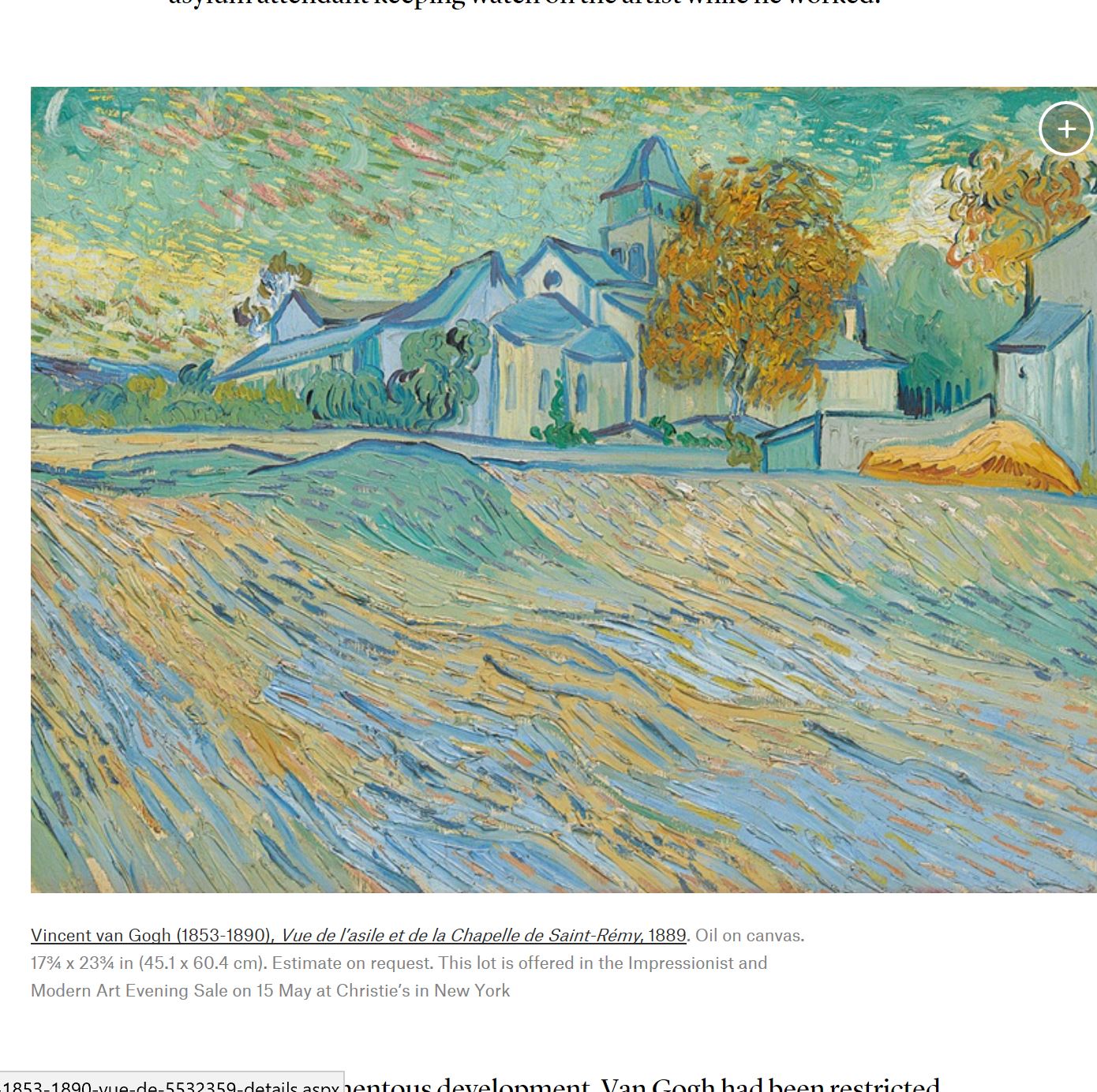
Since the passage in 2016 of the Holocaust Expropriated Art Recovery (HEAR) Act, many commenters (here included) have grappled with what the implications of the law will be on the scope and frequency of future claims. Even as litigants are faced with policy arguments about whether individual claims belong in U.S. courts—arguments that the HEAR Act should have put to rest—it is occasionally worthwhile to consider how prior cases would have been affected. Such analysis can draw into relief why the law was such a significant step forward. This week, news that a painting by Vincent Van Gogh once owned by Elizabeth Taylor will go to auction again provides one such example. A beautiful painting in the collection of the biggest movie star in the world makes for a great sales pitch, but missing in the coverage is any mention of Margarethe Mauthner, a German Jew who owned the painting before fleeing the Nazi regime. The exact circumstances under which she lost possession of the painting are unclear, but those circumstances might have had the chance to be determined had the HEAR Act been passed earlier. The importance of that opportunity is worth considering as the law is assessed going forward.
Read More
Topics:
Margarethe Mauthner,
Nazi-looted art,
Van Gogh,
Christie's,
Holocaust Victims Redress Act,
Sotheby's,
Holocaust Expropriated Art Recovery Act,
HEAR Act,
A Tragic Fate,
Vue de l'asile et de la Chapelle de Saint-Rémy,
Alfred Wolf,
Elizabeth Taylor,
Paul Cassirer
Last week Apollo magazine published my comments about the recent 5Pointz decision. The article can be found here, and the text is reprinted below:
Read More
Topics:
Graffiti Art,
Visual Artists Rights Act of 1990,
VARA,
Jerry Wolkoff,
Copyright,
5Pointz,
Street Art
I am honored to be one of the presenters at an upcoming symposium at Brandeis University entitled "Looted Art for Sale." This interdisciplinary conference will provide an international perspective on the last twenty years of art recovery. Speakers include former Ambassador Stuart Eizenstat, a primary leader in the creation of U. S. restitution policies, Hector Feliciano, Professor Meike Hoffmann, Victoria Reed, Inge Reist, and Lucian Simmons. The filmmaker, John Friedman, will screen excerpts from his forthcoming documentary on Tuesday evening, March 20th (6:30pm), in Edie & Lew Wasserman Cinematheque, “Restitution: Art and Memory.”
Read More
Topics:
Nicholas M. O'Donnell,
Victoria Reed,
Brandeis University,
Lucian Simmons,
Hector Feliciano,
Rosenberg Institute of Global Finance,
Brandeis International Business School,
Inge Reist,
Stuart Eizenstat,
Looted Art for Sale,
Brandeis Center for German and European Studies