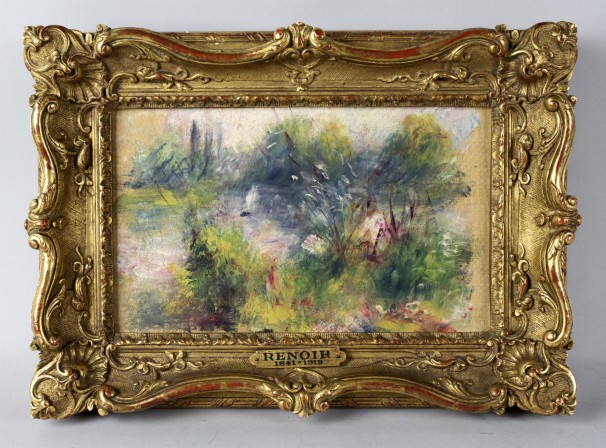
The Baltimore Sun reports that U.S. District Judge Judge Leonie Brinkema allowed the Baltimore Museum of Art’s motion for summary judgment at today’s hearing in Alexandria, Virginia. That means that the BMA is the owner of the painting, not claimant Martha Fuqua, who argued that she bought the painting at a 2009 flea market in good faith. Barring an appeal (or perhaps even with one), the painting will soon return to Baltimore from where it was stolen in 1951.
Read More
Topics:
hearsay,
Pierre-Auguste Renoir,
Potomack Company,
flea market Renoir,
ancient documents,
Der Spiegel,
Martha Fuqua,
Baltimore Museum of Art,
Litigation,
business records exception,
summary judgment,
Museums,
Leonie Brinkema,
Paysage Bords de Seine,
FRCP 56
Judge Leonie Brinkema will hold a hearing tomorrow morning in Alexandria, Virginia on the Baltimore Museum of Art's motion for summary judgment to claim ownership to an 1879 Renoir painting Paysage Bords de Seine that the museum maintains was stolen in 1951. Claimant Martha Fuqua filed a motion to strike the BMA's reply to her opposition, arguing that the museum was introducing new evidence. The court swiftly denied the motion, and noted that the museum was responding to arguments she made for the first time in her opposition to the summary judgment motion (but gave her permission to file a sur-reply).
Read More
Topics:
hearsay,
authentication,
Pierre-Auguste Renoir,
Potomack Company,
flea market Renoir,
ancient documents,
Der Spiegel,
Martha Fuqua,
Baltimore Museum of Art,
Litigation,
business records exception,
summary judgment,
Museums,
Paysage Bords de Seine,
FRCP 56
From Dresden to Aschbach to Düsseldorf—New Scholarship in U.S. Archives Traces Hildebrand Gurlitt at War’s End, Could Affect Cornelius Gurlitt’s Claim to Good Faith Ownership
The Main Post has an article today (in German) by Christine Jeske tracing the late-war and post-war trajectory of Hildebrand Gurlitt and his now-infamous collection. The article is fascinating, and sheds considerable light on how the collection came through the war and how Gurlitt evaded greater scrutiny that might have revealed the trove’s whereabouts earlier. It also puts into context any claim Cornelius Gurlitt might now have to argue he took possession of the paintings from his father unaware of their provenance—what will be a critical argument, particularly if yesterday’s Cultural Property Restitution Law proposal by Bavaria becomes federal law in German.
Read More
Topics:
Wiesbaden,
Cultural Property Restitution Law,
veschollene Kunst,
Franken,
Franconia,
Hildebrand Gurlitt,
Cornelius Gurlitt,
George Clooney,
Erik Berger,
Augsburg,
Dresden,
Nuremberg,
Fall Gurlitt,
Monuments Men,
Gurlitt Collection,
Karl Haberstock,
Kunstverein,
Entartete Kunst,
Munich,
Heiner Dikreiter,
Beutekunst,
Freiherr Gerhard von Pölnitz,
Bavaria,
Kulturgut-Rückgewähr-Gesetz,
Nürnberg,
Düsseldorf,
Schlüsselfeld,
Monuments Fine Arts and Archives,
Gemäldegalerie Dresden,
Christine Jeske,
Walter Paech,
degenerate art,
Städtische Galerie,
München,
Main Post,
Karl and Magdalene Haberstock Foundation,
Raubkunst,
Verjährung,
Nazi Raubkunst,
Aschbach
As reported yesterday, the government of Bavaria has moved ahead with a proposal to amend the statute of limitations over art claims like those arising out of the Gurlitt find in Schwabing/Munich. The “Draft law for the exclusion of limitations on claims for misappropriated cultural property, particularly from the Nazi era (Cultural Property Restitution Law)” would bar the assertion of a statute of limitations where the current possessor does not hold the property in good faith. The draft is now publicly available, here (albeit in German). The proposal is not limited to Bavaria, rather, it is for consideration by Germany’s federal; parliament in Berlin (first the upper chamber, or Bundesrat, followed by the Bundestag).
Read More
Topics:
Berlin,
Ministerin für Justiz und Kultur,
Cultural Property Restitution Law,
veschollene Kunst,
Schwabinger Kunstfund,
Cornelius Gurlitt,
Gurlitt Task Force,
Fall Gurlitt,
Gurlitt Collection,
Kulturgut,
Entartete Kunst,
Declaration of the Federal Government the Länder a,
Munich,
Beutekunst,
Schwabing,
Bundestag,
Bundesrat,
Bavaria,
Kulturgut-Rückgewähr-Gesetz,
degenerate art,
Freistaat Bayern,
Justizminister,
München,
Raubkunst,
Verjährung,
Winfried Bausback
Die Welt reports today that a scheduled cabinet meeting of the government of Bavaria includes discussion of a draft revision to the state’s statute of limitations. Justice Minister Winfried Bausback (CSU) has apparently stated his desire to ensure that claimants like those heirs to owners of works found in Cornelius Gurlitt’s apartment will not be barred by the statute of limitations, following through on statements he made last year after being selected. There has been lively discussion of whether such claims would be time barred, but this revision would presumably be intended to answer the question broadly. It could signal the beginning of legislative steps to address the situation. The previous Justice and Culture Minister Beate Merk had come under heavy criticism, but a new minister may have room to make some changes. And, in a parliamentary system, the consensus of the ruling government is more significant in anticipating the passage of legislation.
Read More
Topics:
Ministerin für Justiz und Kultur,
Legal Tribune,
veschollene Kunst,
Beate Merk,
Cornelius Gurlitt,
Augsburg,
Schwabinger Kunstfund. Kunstfund München,
Gurlitt Task Force,
Germany,
Fall Gurlitt,
Gurlitt Collection,
Die Welt,
Lorenz Kähler,
CSU,
Hildebrand Gurlit,
Entartete Kunst,
Ingeborg Berggreen-Merkel,
Beutekunst,
Magdeburg,
Gurlitt,
Bavaria,
degenerate art,
Freistaat Bayern,
Justizminister,
www.lostart.de,
Nazi art,
Raubkunst,
Verjährung,
Winfried Bausback

The last remaining claimants for the 1879 painting by Pierre Auguste Renoir, Paysage bords de Seine that surfaced in the possession of a woman who claimed to have found it at a flea market, have filed summary judgment papers seeking final disposition of the case without need of a trial. The Baltimore Museum of Art has made its case that the painting was stolen from the museum in 1951, while Martha Fuqua alleges that she purchased it in good faith at a Virginia flea market in 2009 before attempting to sell it at the Potomack Company. The U.S. government seized the painting from the auction house and filed an interpleader action to determine the true owner; the other principle claimant (Fireman’s Fund Insurance) dropped out of the case last fall without explanation, apparently pursuant to an assignment. Heirs of the original donor to the BMA never responded or made claim to the painting. The case will now turn at summary judgment on the hearsay rule, a topic that have bedeviled generations of law students and lawyers.
Read More
Topics:
hearsay,
authentication,
Pierre-Auguste Renoir,
Potomack Company,
flea market Renoir,
ancient documents,
Gurlitt,
Martha Fuqua,
Baltimore Museum of Art,
Litigation,
business records exception,
summary judgment,
Museums,
Paysage Bords de Seine,
FRCP 56
Read More
Topics:
Chapter 9,
11 U.S.C. § 904,
Judge Rhodes,
Christie's,
valuation,
Appraisal,
Detroit,
Detroit Institute of Arts,
Bankruptcy,
Detroit Emergency Manager,
Kevyn Orr,
Detroit Free Press,
eligibility,
Detroit Bankruptcy
After Judge Rhodes of the Bankruptcy Court for the Eastern District of Michigan ruled on December 3, 2013 that the city of Detroit is eligible for Chapter 9 Bankruptcy protection, the city immediately divulged that the report commissioned by the city from Christie’s to appraise the Detroit Institute of Arts (DIA) collection was nearly finished. On the day of the eligibility ruling, Emergency Manager Kevyn Orr and Christie’s announced some tentative conclusions from the report, namely, that the 2,781 works appraised (roughly 5% of the total collection) had a value of approximately $452 million to $866 million. This was considerably lower than many had speculated.
Read More
Topics:
Old Master,
Mark Stryker,
Chapter 9,
Scheme for Decoration of Sistine Chapel Ceiling,
11 U.S.C. § 904,
Impressionism,
Amedeo Modigliani,
Michelangelo,
Judge Rhodes,
Christie's,
valuation,
Appraisal,
Modernist Art,
Detroit,
Eugene Driker,
Detroit Institute of Arts,
Bankruptcy,
Gerald Rosen,
Detroit Emergency Manager,
Kevyn Orr,
Detroit Free Press,
eligibility,
Detroit Bankruptcy
Since the Court of Appeals’ decision in William J. Jenack Estate Appraisers and Auctioneers, Inc. v. Albert Rabizadeh was released on Tuesday (a decision that the New York Times noted was “first reported by the Art Law Report blog”), reactions have started to come in to the decision. Somewhat surprisingly, they have thus far been relatively few in number. On the whole, few seem exercised about the decision, and no one is gloating, probably because it restores the age-old status quo to which everyone had become accustomed.
Read More
Topics:
Legislation,
consignment,
New York General Obligations Law § 5-701(a)(6),
Appellate Division,
Auctions,
New York Court of Appeals,
Ivan Petrovich Khlebnikov,
agency,
Inc. v. Albert Rabizadeh,
New York Supreme Court,
Hicks v. Whitmore,
Morris Cohon & Co. v. Russell,
disclosure,
Statute of Frauds,
anonymous seller,
identity,
auction,
William J. Jenack Estate Appraisers and Auctioneer