Nicholas O'Donnell

Nick’s practice focuses primarily on complex civil litigation. He represents manufacturers, individuals, investment advisers, banks, and others around the world in contract, securities, consumer protection, tort and domestic relations cases, with particular experience in the German-speaking world. He is also the editor of the Art Law Report, a blog that provides timely updates and commentary on legal issues in the museum and visual arts communities, one of his areas of expertise. Nick is a member of the Art Law Committee of the New York City Bar Association. Additionally, Nick has authored and contributed to several books on art law: — A Tragic Fate—Law and Ethics in the Battle Over Nazi-Looted Art, (Ankerwyke/ABA Publishing, 2017) — “Public Trust or Private Business? Deaccessioning Law and Ethics in the United States,” in Éthique et Patrimoine Culturel - Regard Croisés, G. Goffaux, ed., (L’Harmattan, 2016) — “Vergangenheit als Zukunft? Restitutionsstreitigkeiten in den Vereinigten Staaen,” in Ersessene Kunst—Der Fall Gurlitt, J. Heil and A. Weber, eds., (Metropol, 2015) — “Nazi-Looted Art—Risks and Best Practices for Museums,” in The Legal Guide for Museum Professionals, Julia Courtney, ed., (2015, Rowman & Littlefield)

The Supreme Judicial Court of Massachusetts (the state’s highest court) recently issued a surprising decision that permits claims against Harvard arising out of a series of daguerreotypes taken of the plaintiff’s ancestors in the 19th century by famed professor Louis Agassiz to proceed. While the SJC affirmed the dismissal of the plaintiff’s property claims that sought outright ownership, the court reinstated claims for emotional distress. The decision held that the manner in which an educational institution responds to a grievance about something in its possession may itself be actionable in the context of the institution’s relationship to the historical facts. In stretching the bounds of the traditional causes of action for negligent or reckless infliction of emotional distress to reach a sympathetic set of facts, however, the SJC has effectively abolished limits on museum liability for collections created under problematic circumstances where the response to such claims is attacked creatively enough. The issue is not whether the result is fair to Harvard, or whether the plaintiff’s family deserves recognition and justice for what was done—they do. The problem with cases that are hard or impossible to limit is that they may lead to socially positive outcomes in one instance, but can be weaponized in the next. In an era when all manner of actors are politicizing what universities should or shouldn’t teach, this opinion creates innumerable opportunities for mischief. As a result, it raises First Amendment and Due Process concerns that Harvard might plausibly petition the Supreme Court to address.
Read More
Topics:
due process,
Supreme Judicial Court,
SJC,
Harvard,
First Amendment,
Museum of Fine Arts Boston,
NAGPRA,
Tamara Lanier,
negligent infliction of emotional dismiss,
Louis Agassiz,
Daguerreotype,
Renty Taylor,
Delia Taylor,
MFA,
reckless infliction of emotional distress,
Philip Guston,
Drew Gilpin Faust
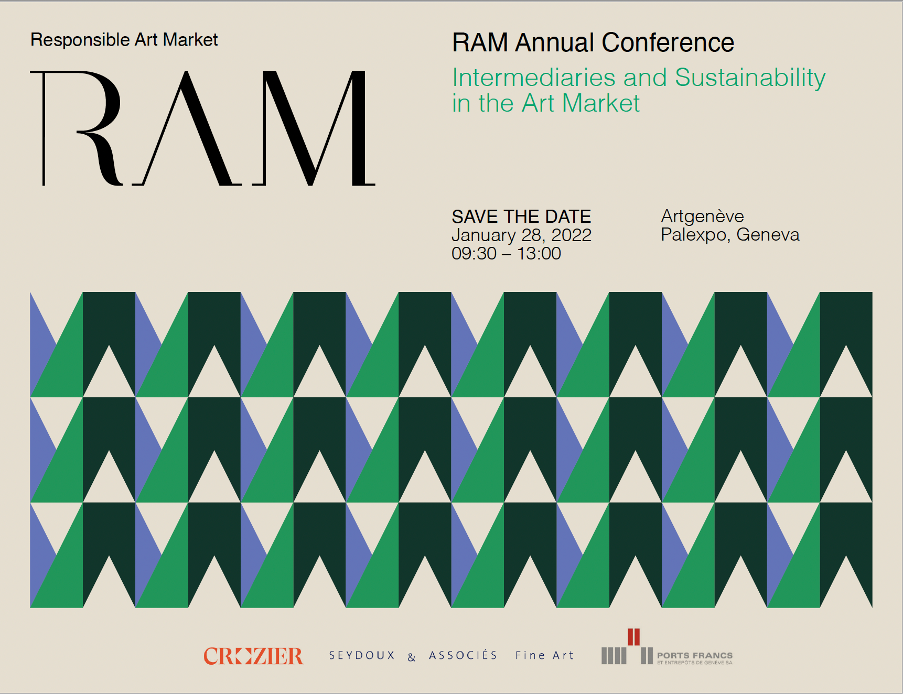
After a two-year hiatus, the Responsible Art Market Initiative is planning a return to its in-person annual conference at the end of this month in Geneva. For anyone who has attended RAM events or used its catalogue of guidance and best practices, this is exciting news and hopefully a chance to gather in a format that has been informative and enjoyable for many years now. As before, the gathering will be at the Palexpo in Geneva and the artgeneve art fair.
This year’s topic is Intermediaries and Sustainability in the Art Market. I am pleased to have shepherded a working group that has drafted practical guidelines for intermediaries in the art market. We will present the guidelines, and then several intermediaries will work through a practical case study. In addition, panelists will discuss the role of sustainability in the marketplace.
Stay tuned for registration information. Obviously conditions are changing rapidly, but I hope to see you in Geneva!
Read More
Topics:
Geneva,
artgenève,
Events,
Responsible Art Market,
Palexpo,
Intermediaries
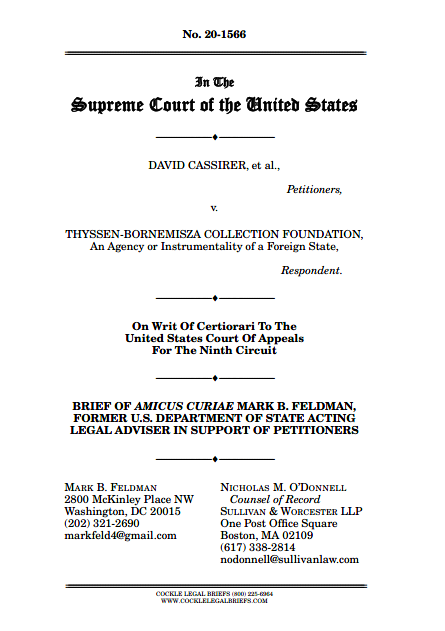
Today I am pleased to announce that I have filed a brief in the Supreme Court of the United States as counsel of record for amicus curiae Mark B. Feldman, former U.S. Department of State Acting Legal Adviser. We filed the brief in the case of Cassirer et al. v. Thyssen-Bornemisza Collection Foundation (“TBC”). Cassirer is the long-running dispute over title to Rue St. Honoré, après-midi, effet de pluie (Rue St. Honoré, Afternoon, Rain Effect) by Impressionist painter Camille Pissarro. The painting once belonged to Lilly Cassirer, a Jewish woman in Berlin in 1939, from whom Nazi agents “bought” the painting. The case before the Supreme Court is not about whether the painting was stolen—it is undisputed that it was. Rather, the Supreme Court will review the Ninth Circuit’s decision that Spanish law, not California law, should govern the ownership rights.
Read More
Topics:
Lilly Cassirer,
Foreign Sovereign Immunities Act,
Supreme Court,
SPK,
Stiftung Preussischer Kulturbesitz,
Hermann Goering,
FSIA,
expropriation exception”,
sovereign immunity,
UNESCO,
Rue St. Honoré,
Camille Pissarro,
Baron Hans-Heinrich Thyssen- Bornemisza,
Cassirer v. Thyssen-Bornemisza Collection,
Welfenschatz,
Jakob Scheidwimmer,
Philipp v. F.R.G.,
Mark B. Feldman

We were privileged to file today a petition for certiorari with the Supreme Court of the United States on behalf of our client, art dealer Alexander Khochinsky. The petition asks the Court for reinstatement of a lawsuit against Poland for lack of subject matter jurisdiction (i.e., sovereign immunity) for Poland’s effort to have Khochinsky extradited from New York as leverage to force him to relinquish a painting that he inherited from his father. The case invokes three provisions of the Foreign Sovereign Immunities Act, 28 U.S.C. § 1605 (the FSIA): the implicit waiver exception, the counterclaim exception, and the non-commercial tort exception. The basis on which we seek the Court’s review is simple: if the holding below is the law, then no one is safe in the United States from any number of rogue regimes that abuse the extradition system for discriminatory and persecutory reasons. To allow this decision to stand is a threat to any American. What if, for example, Turkey pursued a Christian American in similar fashion motivated by religious animus about owning a particular kind of art from the Ottoman Empire? What if the Taliban, now the de facto government of Afghanistan, declared a worldwide intention to find Jews in possession of Pashto cultural property? What if China declared American intellectual property to be revolutionary patrimony?
Read More
Topics:
China,
Alexander Khochinsky,
Holocaust claims,
extradition,
FSIA,
"Girl with Dove",
Foreign Sovereign Immunities,
Poland,
Sullivan and Worcester LLP,
28 U.S.C. § 1605,
Operation Barbarossa,
Taliban,
Afghanistan,
Turkey,
Pashto
The Treasury Department’s Financial Crimes Enforcement Network (FinCEN) today published in the Federal Register notice of proposed regulations related to the implementation of amendments to the Bank Secrecy Act (BSA) regarding the trade in antiquities pursuant to last year’s Anti-Money Laundering Act. After relative silence over the nine months since the AMLA was passed as part of the National Defense Authorization Act, FinCEN somewhat surprisingly still has not drafted any proposed regulations, but rather seeks additional comment on a series of substantive questions. This effort to gather meaningful data is a positive step, but raises concerns about interested parties’ ability to respond by the 30 day deadline, and whether FinCEN will have time to incorporate those comments into regulations that must be promulgated (after further public notice and comment) by the end of 2021.
Read More
Topics:
Antiquities,
AML,
Money laundering,
FinCEN,
Financial Crimes Enforcement Network,
Bank Secrecy Act,
National Defense Authorization Act,
Treasury Department,
BSA,
Anti-Money Laundering Act,
Byzantium
There’s just no other way to say it: the last 18 months have been extraordinarily hard. Professionally, what I have missed the most is the chance to connect with, and learn from colleagues, particularly those far away. It is therefore with great excitement and pride that I can announce that the International Bar Association’s Intellectual Property Section will hold a live, in-person conference next month on trends in IP law. As my second year as co-chair of the Art, Cultural Institutions and Heritage Law Committee winds down, I am so pleased that we will be contributing a panel to this terrific event about, what else, Non-Fungible Tokens. As anyone who has watched my LinkedIn feed this past summer will know, Berlin holds a very special place in my life and so I look forward to making my first trip overseas in a very long time to a city that is like a second home.
The program, to which the several committees organized, is below and registration is open.
Bis zum nächsten Mal in Berlin!
Read More
Topics:
Berlin,
Art Cultural Institutions and Heritage Committee o,
Sullivan & Worcester LLP,
Events,
IBA,
Nicholas M. O'Donnell,
Anne-Sophie Nardon,
Laurent De Muyter,
Blanca Escribano,
Frank P Maier-Rigaud,
ABC Economics,
Anne Vallery,
Katharina Garbers-von Boehm,
Büsing, Müffelmann & Theye,
Martin Wilson,
Phillips Auctioneers,
Johann König,
Elisa Henry,
Ruben A Hofmann,
Paulina Silva,
Grace Nacimiento,
Laurent Schummer,
Luc Govaert,
Joanne Wheeler,
Jason Jarvis Jardine,
Nazli Cansin Karga Giritli,
Novartis,
Niko Härting,
Sajai Singh,
Martin Viciano Gofferje,
Borghese Associes,
KÖNIG GALERIE,
Erik Valgaeren,
Özge Atilgan,
Corey Salsberg,
Felix Engelhardt,
Christine Graham,
Volodymyr Yakubovskyy

I am pleased and humbled to report that Chambers and Partners has issued its 2021 High Net Worth Guide Rankings, and that I was ranked as a Band 2 Ranked Individual in Art and Cultural Property Law rankings for the United States. Chambers is a thorough and highly regarded practice ranking, and the recognition is a validation of the art law team at Sullivan at the ten-year anniversary of our practice group. From the rankings:
Nicholas O'Donnell of Sullivan & Worcester in Boston is principally known for his work on restitution matters. "He is well known in the restitution field and writes very frequently on the subject," says a source, adding: "He is extremely eloquent and knowledgeable on the subject." Another source says that "Nick O'Donnell is an exceptional lawyer," and has written what this source describes as "the leading book on Nazi looted art from a legal perspective." Several sources highlight O'Donnell's recent work on perhaps the most high-profile art restitution case in decades, the Guelph Treasure matter which went to the US Supreme Court in December 2020. One international interviewee says that "his knowledge of restitution cases, particularly in Austria and Germany, is unparalleled from a US perspective," adding that "on restitution-related art matters, he really stands head and shoulders above others."
Read More
Topics:
MItchell Stein,
art law,
Supreme Court,
Restitution,
Sullivan & Worcester LLP,
Restitution and Repatriation,
International Bar Association,
Responsible Art Market,
Chambers and Partners,
Erika Todd
Last week, on behalf of our client Alexander Khochinsky, an art dealer, we filed a petition to rehear en banc the June 18, 2021 decision by a three-judge panel affirming the dismissal of the lawsuit against Poland for lack of subject matter jurisdiction (i.e., sovereign immunity). The case invokes three provisions of the Foreign Sovereign Immunities Act, 28 U.S.C. § 1605 (the FSIA): the implicit waiver exception, the counterclaim exception, and the non-commercial tort exception. The basis on which we seek rehearing is simple: if the holding of the District Court and panel of the DC Circuit is the law, then no one is safe in the United States from any number of rogue regimes that abuse the extradition system for discriminatory and persecutory reasons.
Read More
Topics:
Alexander Khochinsky,
Holocaust,
extradition,
FSIA,
"Girl with Dove",
Poland,
Operation Barbarossa,
Law and Justice Party,
Judge Rakoff,
SDNY

It has been a great source of pride that in the last year, the Art, Cultural Institutions and Heritage Law Committee of the International Bar Association has remained active and engaged with issues of art and cultural property law despite the pandemic. We had a very exciting in-person program organized and ready to go for June, 2020 at the Ecole du Louvre, where I snapped this picture in February 2020 expecting to be back just four months later. Fate intervened, of course, but with thanks to my co-chair last year Giuseppe Calabi, and my co-chair starting January 1 of this year Anne-Sophie Nardon, we have held a webinar in June, a panel at the IBA’s Virtually Together conference, and stayed active in our publications and newsletter. Cultural property and commercial art law certainly hasn’t taken a break for the pandemic, and while I very much miss our in-person gatherings, it has allowed us to reach new members and grow the ranks of our officer team. We are ever larger and more diverse, with officer representation from every continent except Australia (and Antarctica--so far!).
Read More
Topics:
Karen Sanig,
Anne Laure Bandle,
Sullivan & Worcester LLP,
Nicholas M. O'Donnell,
Mishcon de Reya,
Art Loss Register,
Court of Arbitration for Art,
Sharon Hecker,
Anne-Sophie Nardon,
Borel & Barbey,
Olivier de Baecque,
Giuseppe Calabi,
Davina Given,
Armstrong Teasdale LLP,
Stan Putter,
Angell Xi,
Jingtian & Gongcheng,
Reynolds Porter Chamberlain,
James Ratcliffe,
CBM & Partners Studio,
Klaus-Jürgen Kraatz,
Kraatz & Kraatz,
Noor Kadhim,
Smallegange,
Steve Schindler,
Schindler Cohen & Hochman
In connection with the late-2020 amendment to the Bank Secrecy Act (BSA) to include “dealers in antiquities” as a result of its inclusion in the National Defense Authorization Act (NDAA), the Treasury Department’s Financial Crimes Enforcement Network (FinCEN) has issued a notice of “Efforts Related to Trade in Antiquities and Art.” The notice is a combination of guidance to entities now covered by the BSA, but it is also a potential backdoor around the entities that Congress chose not to regulate with respect to potential or perceived money laundering risks: art dealers. It also raises concerns about the objectivity of the forthcoming study of the art market that Congress instructed FinCEN to conduct. In either event, it is further evidence that momentum continues to gather for stricter oversight and regulation of the U.S. art market, and the importance of the art trade demonstrating more transparency and diligence if it hopes to modify or mitigate that regulation.
Read More
Topics:
The Art Newspaper,
Nazi-looted art,
Antiquities,
Terrorist financing,
Responsible Art Market initiative,
Money laundering,
FinCEN,
A Tragic Fate,
Financial Crimes Enforcement Network,
Illicit Art and Antiquities Trafficking Protection,
suspicious activity reports,
Corporate Transparency Act of 2019,
Bank Secrecy Act,
National Defense Authorization Act